Groundwater depletion explained simply means this: groundwater is the water stored underground in aquifers, and it is being pumped out faster than rain and snowmelt can refill it. When withdrawals beat recharge year after year, the water table drops. Wells go deeper, springs weaken, and in some places the ground itself begins to sink.
If rain keeps falling, why does the underground supply still shrink? It is a fair question and the most common objection to the whole subject. Water is always cycling, so nothing should ever run out, right? The answer is that a cycle can be fast in one place and almost frozen in another. A river refills within days of rain. The deep water your tap or your farm well depends on may take centuries to rebuild, if it rebuilds at all.
Below is a plain-language walkthrough of what is happening, who it affects first, and what actually moves the needle.
Table of Contents
- Groundwater Depletion Explained Simply: The Basics
- How Much Water Is Stored Underground?
- What Is Groundwater Depletion Explained Simply
- What Causes Groundwater Levels to Fall?
- How Does Groundwater Depletion Affect People and Ecosystems?
- How Can We Tell Whether Groundwater Is Being Depleted?
- Does Climate Change Make Groundwater Depletion Worse?
- What Can Be Done to Reduce Groundwater Depletion?
- Where Should Individuals Start?
- Frequently Asked Questions
- Is groundwater depletion the same as drought?
- Can groundwater depletion be reversed?
- How can I tell if my private well is affected?
- Does more rain always refill an aquifer?
- What is the main cause of groundwater depletion in Spain?
- Can individual households do anything to protect groundwater?
- Conclusion: Protect the Water Below Our Feet
Groundwater Depletion Explained Simply: The Basics
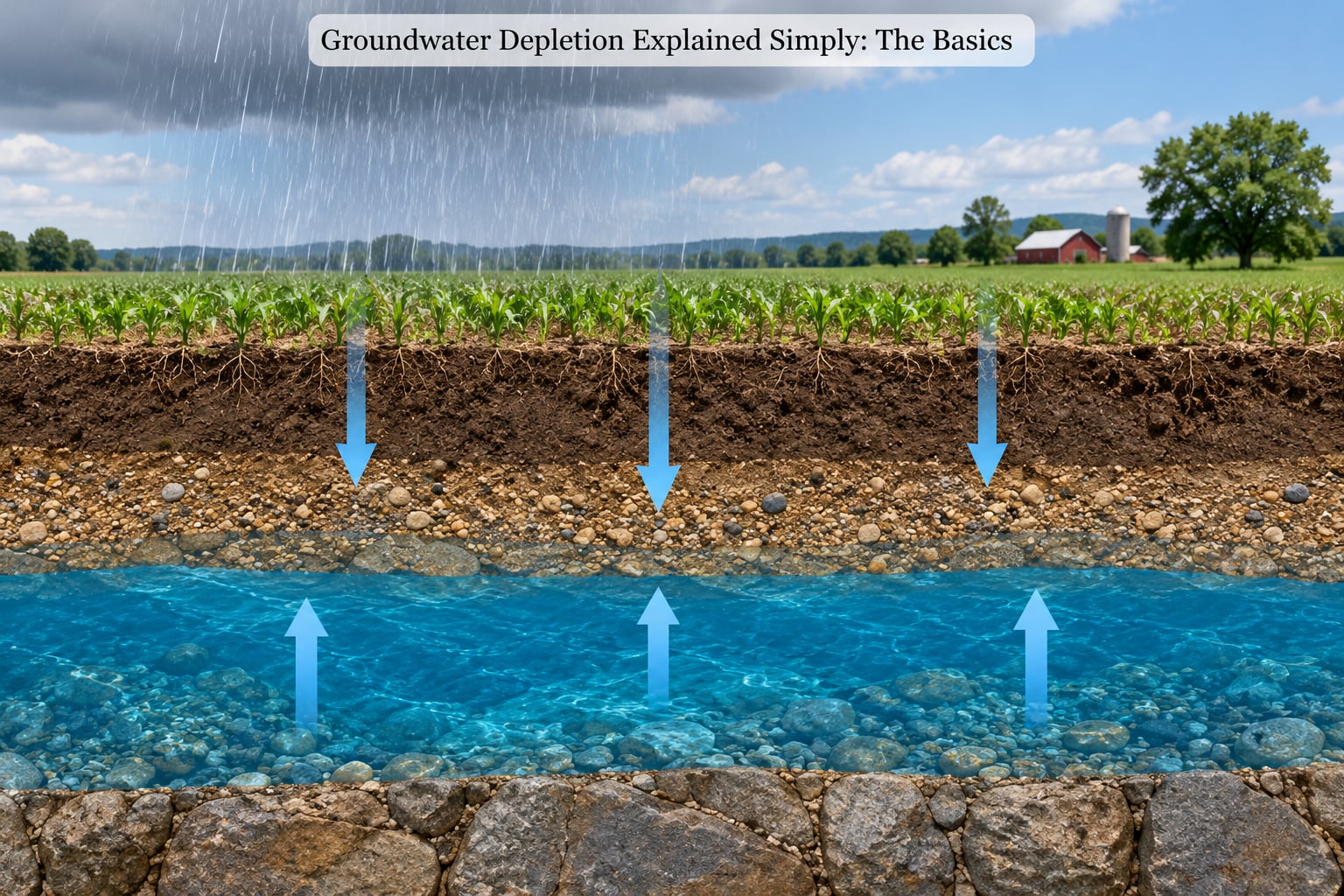
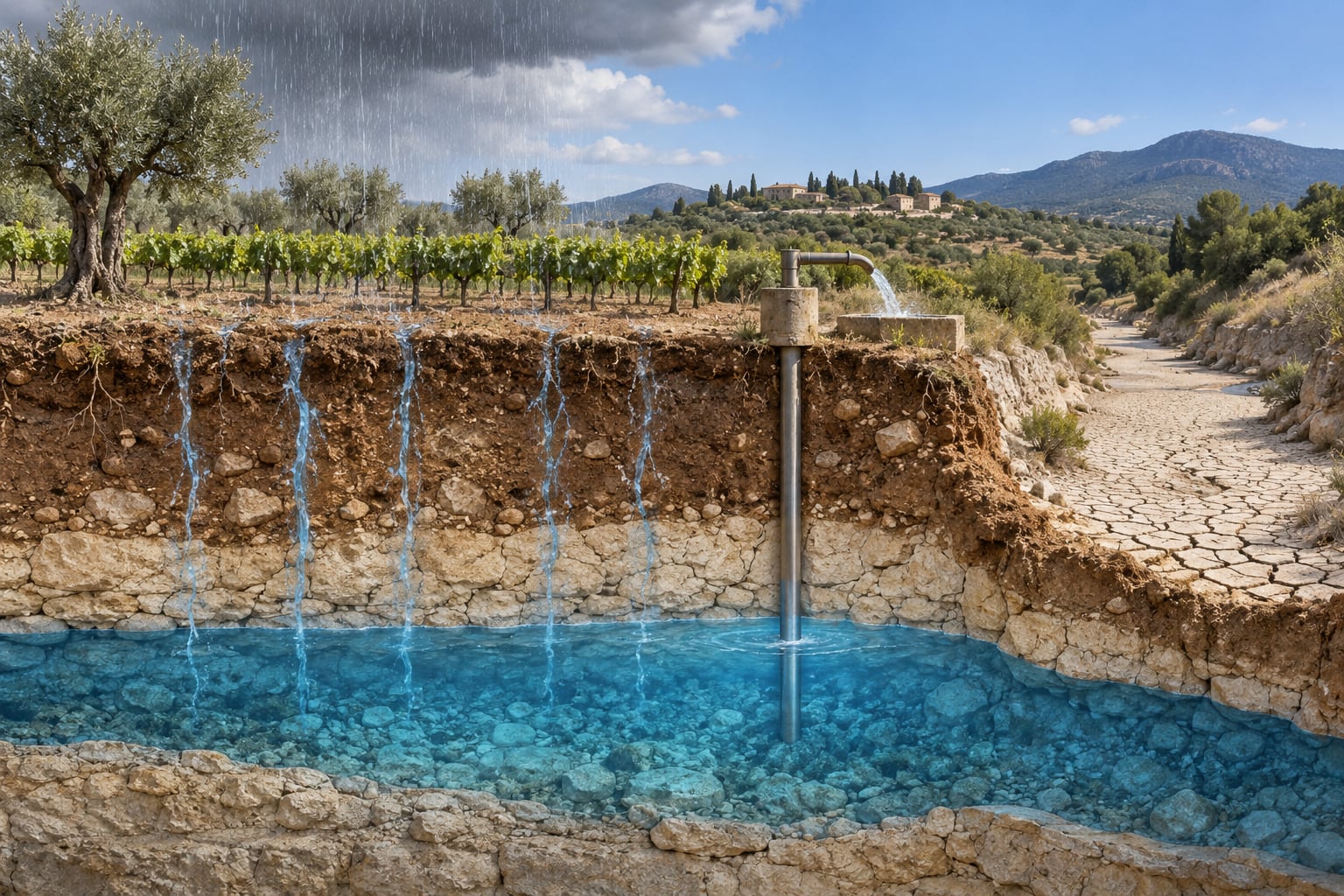
Groundwater depletion is the long-term decline of the water table, the top surface of the saturated rock below your feet, caused by pumping groundwater out faster than nature can replace it. An aquifer is a body of waterlogged sand, gravel or fractured rock that stores groundwater and passes it along slowly, pore by pore. Rain falling on the recharge area above the aquifer seeps down and adds to the store over years or decades.
Two things get confused here. Seasonal variation is normal: water levels drop in summer and rise in winter, and recover each year. Depletion is a sustained decline that does not come back, year after year, measured against the same wet season.
How Much Water Is Stored Underground?
Most of Earth’s liquid fresh water is not in rivers or lakes. It sits underground, frozen in ice, or held in soil. The underground share is the largest single store, and it is also the slowest to refill.
| Where the water is | How it is held | How fast it refills |
|---|---|---|
| Groundwater in an aquifer | Waterlogged pores and cracks in rock and sediment | Years to centuries, or effectively never |
| Rivers and lakes | Flowing and standing surface water | Days to weeks after rain |
| Soil moisture | Thin film of water around soil grains | Hours to days |
| Rainfall | Water in the atmosphere and during storms | Continuous, but much runs off or evaporates |
| Water taken up by plants | Transpired through leaves and stems | Days, drawn mostly from soil and shallow roots |
Two more terms come up constantly. The recharge zone is the land surface where water can soak down into an aquifer; the aquitard is a dense clay layer that slows or blocks that movement and separates one aquifer from the next.
What Is Groundwater Depletion Explained Simply
Think of a household rainwater tank. Rain fills it, and you draw from it for the garden. In a wet winter you refill what you took, so the level holds steady. In a long dry run the tank empties further with every bucket, because the tap that refills it is small.
An aquifer works the same way, only with the volumes turned up by a factor of millions and the tap turned down to a trickle. Most groundwater depletion means withdrawals exceed recharge over time. That shortfall is what moves the water table.
One myth to clear up early: an aquifer is not an underground lake. There is no cavern of water you could walk into. It is wet rock and sand that hold water in the spaces between grains, and it releases that water slowly as pressure pushes it toward a well.
What Causes Groundwater Levels to Fall?
The causes rank fairly clearly by how much water they move.
- Agricultural irrigation. Across southern Spain, the Mediterranean coast and most of the world’s irrigated land, pumping for crops takes the majority of the water. Double-cropping systems intensify the problem because they irrigate twice in a season.
- Drought and reduced rainfall. Recharge falls during dry spells. Several poor years in a row stack up, and aquifers with slow refill cannot catch back up.
- Population growth and urban demand. Towns and cities add households, industry and lawns, often drawing from the same aquifer as the farms around them.
- Industrial use. Food processing, textiles and cooling typically draw a smaller share, but often from a concentrated local source.
- Sealed soil. Asphalt, concrete roofs and compacted land stop rain soaking down. More of each storm runs off into drains instead of becoming recharge.
- Wetland drainage and river diversions. Drained marshes and water diverted into canals never get to infiltrate, so the aquifer loses one of its natural inputs.
- Groundwater-dependent ecosystems. Springs, marshes and streambeds that are fed by the water table lose that connection when the table drops far enough.
How Does Groundwater Depletion Affect People and Ecosystems?
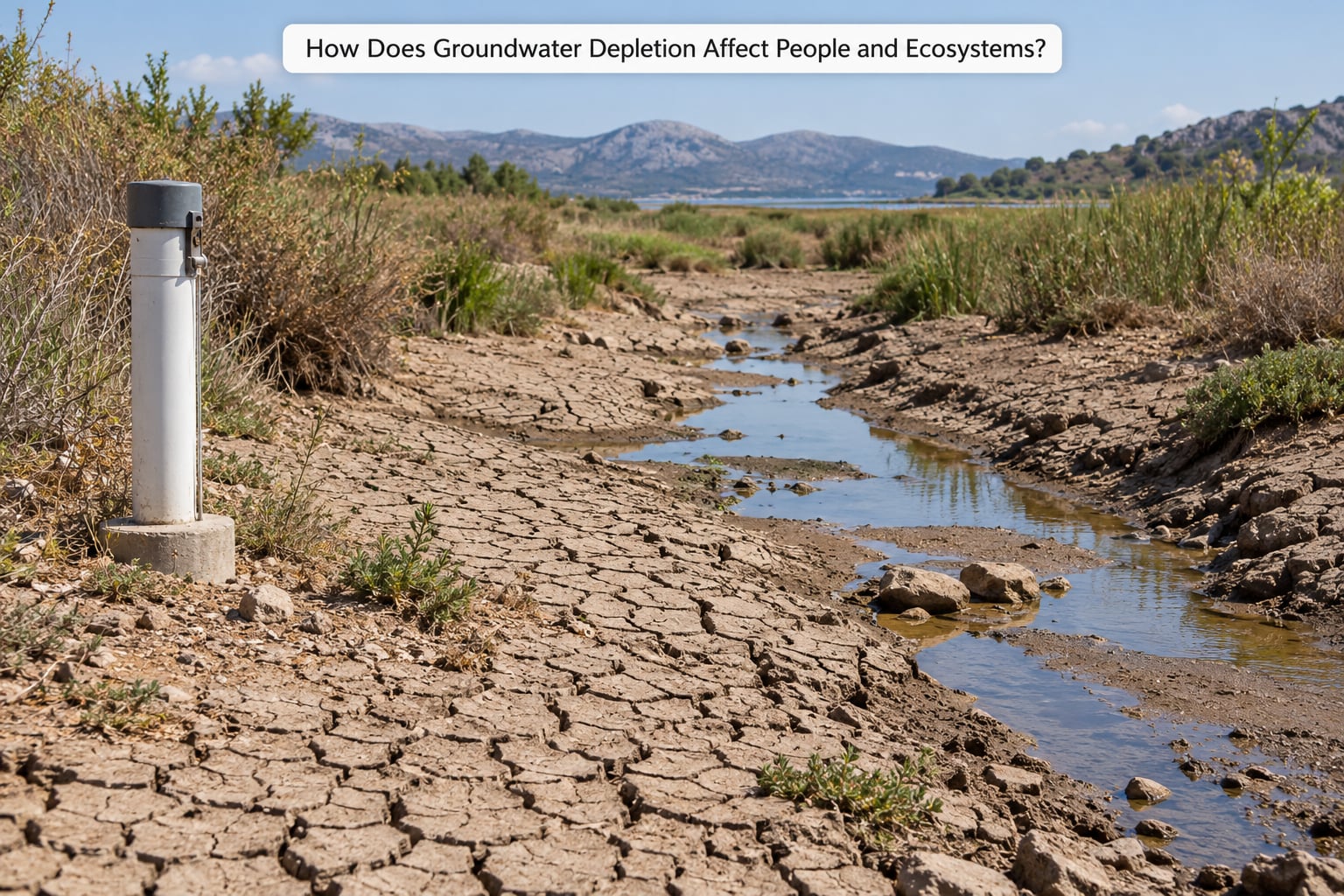
The effects arrive in a fairly predictable order, starting with the people closest to the water.
Wells start to fail. A domestic well that reached water for thirty years can run dry once the table falls a few metres below its screened interval. Rural households then pay to drill deeper or to have water delivered, as some communities in India and elsewhere have been doing for years.
Salt creeps in. Near coasts, pumping pulls the water table below sea level, and saline groundwater moves inland to replace what was removed. Wells that were fresh become brackish. This is saltwater intrusion, and it is why “just drill deeper” fails near the shore.
The ground sinks. When water is removed from pore spaces in soft clay or sand, those spaces compact and the surface drops. Houston has recorded roughly ten feet of subsidence from decades of heavy pumping. Cracks appear in roads, pipes and buildings.
Streams and wetlands lose their baseflow. In healthy rivers, groundwater keeps flowing into the channel between rain events. As the water table falls, that contribution weakens, so streams run low or dry and marshes dry out at the edges.
Water quality can shift. Pumping speeds up the movement of water through an aquifer, which can draw more naturally occurring arsenic, salts or industrial contaminants into a supply that tests clean today.
Costs rise and competition sharpens. Lifting water from greater depth takes more energy, which pushes up household bills and production costs. Going deeper does not solve the problem so much as move the ceiling down on what is left.
How Can We Tell Whether Groundwater Is Being Depleted?
A single observation tells you very little. A well reading in August will be lower than one in March even in a healthy aquifer, and one dry well proves nothing on its own. What matters is the trend.
Hydrogeologists rely on several layers of evidence. Monitoring wells and piezometers measure water level at a fixed depth over decades, which turns a guess into a series. Rainfall and recharge records show whether a decline is explained by a dry period or is running ahead of it. Abstraction records and licence data show how much is being pumped and by whom.
At regional and global scale, satellite gravimetry missions such as GRACE measure tiny changes in Earth’s mass, picking up the loss of water stored in ice, soil and groundwater. Satellite gravity recovery is too coarse to settle a dispute between two neighbouring wells, but it reliably shows which large regions are losing water and which are not.
Finally, groundwater flow models put the measurements together and test what happens under different scenarios, such as reduced pumping or reduced rainfall.
One useful counterweight to the doom framing: the 2024 global assessment by Perrone and Jasechko, published in Nature, found declining levels in about 71% of 1,693 assessed aquifer systems, with the decline accelerating since 2000. The same study found roughly 16% had stabilised or recovered. Neighbouring aquifers can move in opposite directions, so local data beats global headlines.
Does Climate Change Make Groundwater Depletion Worse?
Usually yes, through three channels rather than one.
More evaporative loss. Hotter air and warmer soil take more moisture before it ever reaches the water table, so a smaller share of each year’s rain becomes recharge.
Higher irrigation demand. Crops need more water per hectare in hotter conditions, and farmers irrigate earlier and longer, which pulls more from the aquifer.
Rain that runs off instead of soaking in. Intense downpours arrive faster than the soil can absorb them. Water flashes across the surface into drains and rivers, carrying less recharge to depth even when total annual rainfall stays similar.
Regional rainfall patterns vary widely, and some places may get more precipitation. What is consistent is the shift toward more variable rainfall and higher evaporation, which makes recharge less reliable even where the yearly total has not moved.
What Can Be Done to Reduce Groundwater Depletion?
Measures fall into two groups: those that work almost anywhere, and those that depend on your geology and water law.
Works everywhere:
- Use water more efficiently. Fixing leaks and choosing efficient fixtures reduces demand without changing anyone’s way of life.
- Shift away from the thirstiest crops in the driest places, or move their growing season to cooler months.
- Improve irrigation scheduling. Drip systems and soil moisture sensors apply water to roots instead of to the air.
- Make more land permeable. Permeable paving, green roofs and soil restoration let rain soak in instead of running to the drain.
- Protect recharge zones. Keeping industrial sites, landfill and intensive activity off permeable ground where aquifers are shallow is cheap insurance.
- Publish monitoring data. People cannot manage a resource whose trend they cannot see.
Depends on local geology and water law:
- Managed aquifer recharge, which stores surface water underground on purpose during wet periods. The 2024 assessment notes it can hold roughly six times more water per unit of spending than an above-ground reservoir of the same cost.
- Extraction permits and metering, which only work where the authority has the power to cap pumping and the resources to enforce it.
- Aquifer coordination across administrative boundaries, since water ignores the lines drawn on a map.
- Managed aquifer recharge through water reuse, where treated wastewater is a realistic supply.
Regulation alone rarely works. It works when paired with cheaper alternatives for growers and enough lead time to adapt.
Where Should Individuals Start?
Start by finding out where your water actually comes from. A public supply is usually a mix of surface water, treated reuse and aquifer water, managed by a company or consortium you can ask for abstraction data. A rural property may sit on a private well drawing from a shared aquifer, in which case your neighbour’s pumping affects your level directly.
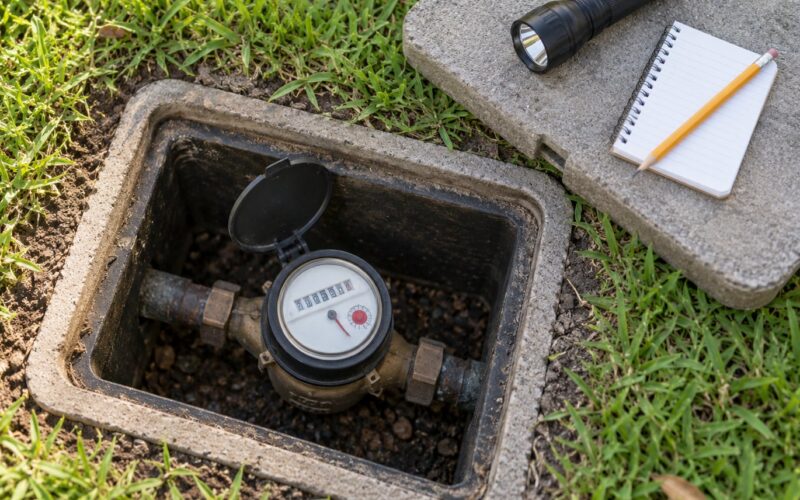
Then read your meter. Most people have no idea what their household uses compared with an average, and the number is usually more persuasive than any statistic in this article.
Fix the small leaks, stop watering at midday when evaporation is highest, and choose plants suited to your climate rather than a different climate. Finally, ask your local water authority or regional hydrogeological service for the monitoring well records for your area. That is public data, it is free, and it turns a vague worry into a number.
Frequently Asked Questions
Is groundwater depletion the same as drought?
No. Drought is a shortage of rainfall and surface water over weeks or months, and it can end quickly with a single storm. Groundwater depletion is a decline in stored underground water that keeps going as long as pumping exceeds recharge, so it persists long after the rain returns. A drought makes depletion worse by cutting recharge, but they are separate processes with different timescales.
Can groundwater depletion be reversed?
Partly. Where aquifers hold shallow water and recharge responds quickly, cutting abstraction can bring water levels back within years. Deeper, slowly recharged aquifers are a different matter, and some behave like a one-off fossil store. The 2024 Nature assessment found around 16% of 1,693 studied aquifer systems had stabilised or recovered, mostly where deliberate management was applied.
How can I tell if my private well is affected?
Watch the water level, not just the flow. A sudden drop in pumping suction, cloudy water, a change in taste, or a longer time for the pump to fill the tank all point in the same direction. Keep a simple monthly note and compare it with the same month a year earlier. If levels keep falling, ask your regional hydrogeological service whether a monitoring well covers your area, since nearby wells often tell the regional story.
Does more rain always refill an aquifer?
No. Rain that falls as intense storms often runs off sealed or saturated ground faster than it can infiltrate. What reaches the water table also has to get past plant roots and summer evaporation first. And in low-permeability rock with a clay aquitard below, a small share of rainfall ever reaches the aquifer. More rainfall helps, but how much actually becomes recharge depends on geology, soil cover and intensity.
What is the main cause of groundwater depletion in Spain?
Irrigated agriculture is the dominant driver in Spain, particularly in the Guadalquivir valley, the Guadalajara basin and the south-east basins supplying intensive crops and greenhouses. Municipal and industrial use matters more in some coastal areas, and household wells in rural zones feel the consequences of the same pumping. The pattern matches most of the Mediterranean: high demand meets low and unpredictable recharge.
Can individual households do anything to protect groundwater?
Your personal use is a small share of regional abstraction, so a single household will not change a water table. What you can do is straightforward: fix leaks, cut irrigation at midday, choose drought-tolerant planting, and ask your water supplier where your water comes from. Voting pressure for published monitoring data and demand management does more than any tap washer, because it is the household decisions that set the rules.
Conclusion: Protect the Water Below Our Feet
Groundwater depletion is not a mystery and it is not a permanent verdict. It happens whenever we take more water out of an aquifer than rain puts back, and the falling water table is the clearest evidence that the balance has tipped.
What matters most is demand management, because the water we do not pump is the water we do not have to find later. Protecting the springs, marshes and streams that depend on the water table matters too, because they are the visible part of the same system.
If you take one action this week, make it this one: find out where your water comes from and request the local monitoring well records. Then read your meter.