If your tap water tastes fine and you have no known contamination, a carbon filter is usually enough. If you are on a well, dealing with high total dissolved solids, or worried about lead, nitrates or PFAS, reverse osmosis removes far more — at the cost of minerals, water waste and upkeep. Comparing reverse osmosis vs carbon filter for drinking water comes down to what is actually in your water, not to marketing copy.
Most households never look. They buy a filter on instinct and then wonder why the water tastes flat, or why the kitchen tap runs dry whenever the dishwasher is on. Those are the two failure modes of picking the wrong method, and both are avoidable.
I have compared laboratory results, certification standards and homeowner reports for both methods, and the honest summary is that neither wins across the board. Reverse osmosis is the most thorough household treatment available today. Carbon filtration is the most sensible default for people on a well-run municipal supply. Here is where each one actually earns its place.
Table of Contents
- Reverse Osmosis vs Carbon Filter for Drinking Water at a Glance
- How Purification and Filtration Differ
- Why every reverse osmosis system already contains carbon
- Reverse Osmosis vs Carbon Filters: What Each Removes
- What are the downsides of using reverse osmosis filters?
- What are the downsides of using a carbon water filter?
- Reverse Osmosis vs Carbon Filter: Taste, Water Quality, and Health
- What water is better than reverse osmosis?
- Is reverse osmosis water bad for you because it removes minerals?
- Let a water test settle the argument
- Reverse Osmosis vs Carbon Filter: Cost, Maintenance, and Convenience
- Replacement schedule you can write on a calendar
- Flow rate, pressure and the cabinet
- Reverse Osmosis vs Carbon Filter: Environmental Impact
- Which Should You Choose?
- Four steps to the right choice
- What the NSF/ANSI numbers actually certify
- How to read your water quality report
- Frequently Asked Questions
- Is reverse osmosis better than a carbon filter for drinking water?
- Can a carbon filter remove PFAS or lead?
- Does reverse osmosis remove bacteria and viruses?
- Is reverse osmosis water bad for you because it removes minerals?
- How often do reverse osmosis systems and carbon filters need replacing?
- What are the downsides of using a carbon water filter?
- Final Recommendation
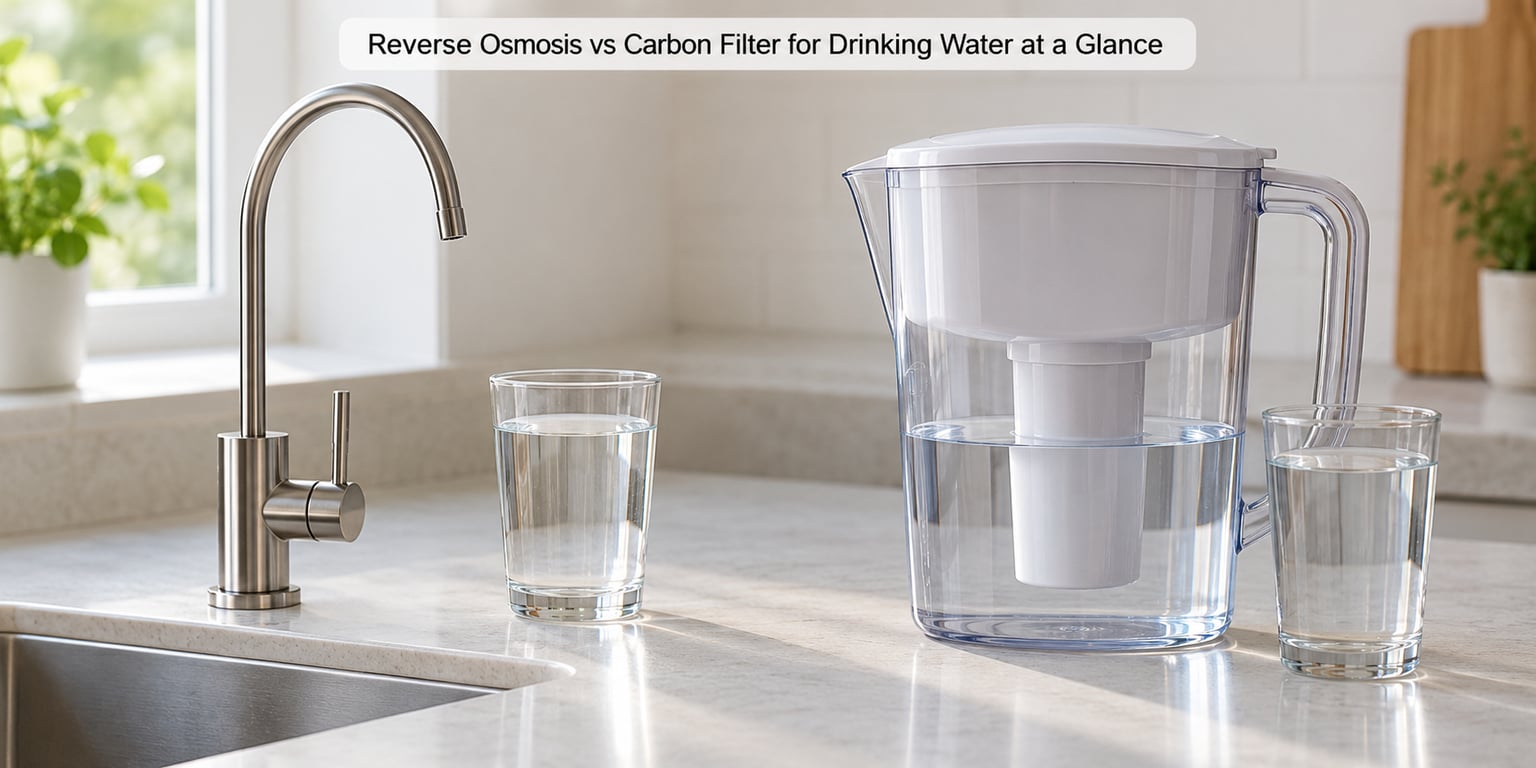
Reverse Osmosis vs Carbon Filter for Drinking Water at a Glance
| Factor | Reverse osmosis | Carbon filter |
|---|---|---|
| How it works | Pressurised water is forced through a semipermeable membrane with pores around 0.0001 microns | Water passes through porous activated carbon that adsorbs selected contaminants onto its surface |
| Dissolved solids and salts | Strong reduction — the main advantage of RO | Essentially none |
| Chlorine, chloramine, taste and odour | Handled by the carbon stages built into every RO system | The core purpose of the filter |
| Nitrates, fluoride, arsenic, most heavy metals | Strong reduction | Poor, except in specialty media such as bone char or certified lead cartridges |
| PFAS | Strong reduction when the membrane is in good condition | Model-dependent; only filters certified for PFAS should be relied on |
| Bacteria, viruses, protozoa | Very high reduction, but never a substitute for disinfection | No reduction |
| Taste | Neutral and flat; remineralisation cartridges exist for this reason | Clean and mineral-forward, keeps the character of the source water |
| Flow rate | Slow without a storage tank; useful capacity is quoted in gallons per day | Instant, unrestricted flow at roughly the tap’s pressure |
| Electricity | Not required for standard tank systems; tankless models with booster pumps need a socket | Never |
| Water wasted | Conventional systems send three or more gallons to the drain for each gallon of drinking water | None |
| Installation | Under-sink, needs a drain line, a feed valve and space for a tank | Often a fifteen-minute job; faucet-mount, pitcher or countertop |
| Ongoing maintenance | Three to four cartridge types plus membrane and tank filter replacement | One cartridge, replaced on a schedule |
| Ongoing cost profile | Higher, because parts are more numerous and the membrane is a consumable | Lower, because there is a single consumable |
| Bottled water replaced | Well — purified water at tap convenience | Partly — enough if your only objection was taste and odour |
| Best fit | Well water with unresolved contaminants, high TDS, lead service lines, known PFAS or nitrate | Good municipal water where the complaint is chlorine taste, odour or sediment |
Read that table as two different jobs rather than a scorecard. One method removes what is dissolved in the water, and the other removes what is floating in it or reacting with it chemically.
How Purification and Filtration Differ
Reverse osmosis is a purification step. Household line pressure pushes water toward a membrane wound tightly enough that water molecules pass through while most dissolved substances do not. The clean water, called permeate, goes to a storage tank or straight to your glass. Everything the membrane rejected goes down a drain line as concentrate.
Because it works by size exclusion rather than by targeting specific chemicals, reverse osmosis is broad. It does not need to know in advance whether the water contains fluoride, nitrate, sulfate or a trace metal. It simply strips dissolved material regardless of what that material is.
Carbon filtration is a targeted step. Activated carbon is a solid with an enormous internal surface area, and contaminants stick to that surface through adsorption — a bonding process, not a sieve. Granular activated carbon sits loose in a housing, while a carbon block is compressed into a cartridge shape that also traps fine sediment in the pores.
That distinction matters more than it sounds. Adsorption has a finite capacity, so a carbon filter works until the media is saturated and then quietly stops. That is the single most important practical difference between the two methods.
Why every reverse osmosis system already contains carbon
Chlorine attacks thin-film membranes. Any meaningful exposure degrades the polyamide layer, and the membrane starts passing what it was installed to hold back. This is why nearly every RO unit ships with a carbon pre-filter, and most add a carbon post-filter as well.
So if you are choosing between the two, carbon is rarely a rival to RO. In most configurations it is a component of it. Homeowners on r/WaterTreatment make this point repeatedly: carbon protects the membrane, the membrane does the heavy lifting, and the post-filter exists mainly to take the flat edge off the taste.
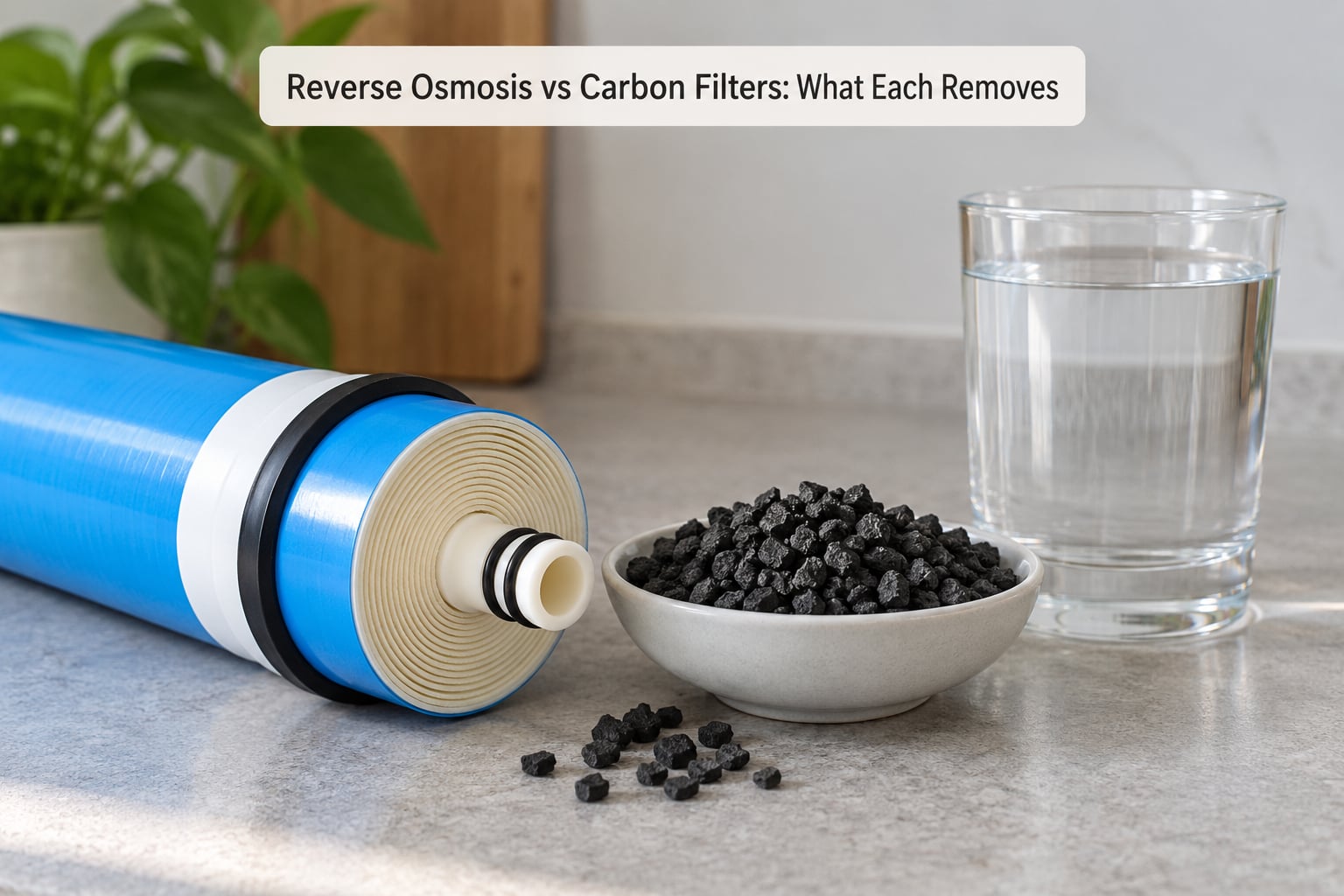
Reverse Osmosis vs Carbon Filters: What Each Removes
| Contaminant | Reverse osmosis | Carbon filter |
|---|---|---|
| Sediment, rust, sand | Yes, via the pre-filter stage | Yes, especially carbon block media |
| Chlorine | Yes, through its carbon stages | Yes, the primary purpose |
| Chloramine | Partly; needs adequate carbon contact time | Partly; catalytic carbon handles it better than standard carbon |
| Taste and odour compounds | Yes, effectively removes them | Yes, effectively removes them |
| Trihalomethanes and disinfection byproducts | High reduction | Good reduction with sufficient contact time |
| Volatile organic compounds | High reduction | High reduction; EPA notes granular activated carbon is well established for VOCs |
| Lead and copper | High reduction | Only with media certified for lead, such as bone char or specific cartridges |
| Nitrates and nitrites | High reduction | Poor; requires ion exchange media |
| Fluoride | High reduction | Poor unless specialty media is used |
| Arsenic | High reduction | Poor unless specialty media is used |
| PFAS | High reduction | Model-dependent; check for an NSF/ANSI 401 claim for the specific compound |
| Total dissolved solids, hardness | High reduction — strips minerals along with contaminants | None |
| Bacteria and viruses | Very high reduction, but not a disinfection guarantee | None |
Use that table as a screening tool, not a promise. No household filter removes everything, and the label tells you only what a specific unit was tested to reduce — not what your water happens to contain.
What are the downsides of using reverse osmosis filters?
Reverse osmosis strips dissolved minerals, which is why the water can taste flat. It wastes three or more gallons of water for every gallon you drink. It needs a storage tank, a drain line and under-sink space, it runs slower than a normal tap, and it costs more to keep going because you replace several filter types plus the membrane every two to three years.
What are the downsides of using a carbon water filter?
A carbon filter does nothing about dissolved solids, nitrates, fluoride or most heavy metals, and it cannot remove bacteria or viruses. Its media saturates on a schedule and then the filtration quietly declines. Push past the replacement date and you are paying for water that tastes fine but may no longer be treated.
One more thing worth saying plainly: neither method makes untreated water safe. If a private well has tested positive for coliform or another microbial marker, filtration is not the answer — disinfection and, in most cases, professional treatment is. The CDC recommends regular testing for private wells precisely because the water is not monitored by a utility.
Reverse Osmosis vs Carbon Filter: Taste, Water Quality, and Health
Taste is where the two methods part company most visibly. Reverse osmosis produces water that is nearly mineral-free, and most people describe it as clean but flat, especially when used with a kitchen faucet aerator. Adding a remineralisation cartridge puts a small amount of calcium and magnesium back in, and a surprising number of people find that solves it completely.
Carbon-filtered water keeps the mineral content of its source. It tastes lighter than unfiltered water but retains more body, which is why carbon is often described as improving taste rather than neutralising it. Carbon also tends to handle disinfection byproducts from chlorinated water very well, which is a taste benefit and a safety benefit at once.
What water is better than reverse osmosis?
For most people on sound municipal water, carbon-filtered water is the better drinking water. It keeps minerals, tastes fresher, costs less to run, wastes no water and flows instantly. Reverse osmosis only wins on the breadth of contaminant removal, and on a supply that already meets standards that advantage is often paying for something you did not have.
Is reverse osmosis water bad for you because it removes minerals?
The concern is usually framed as being hard on the kidneys, but that is the wrong framing. The real issue is only whether water is expected to supply meaningful calcium or magnesium, and mainstream dietary guidance treats drinking water as a small contributor to mineral intake compared with food. Properly maintained reverse osmosis water is generally considered suitable to drink. People with specific medical conditions affecting mineral balance should ask their doctor rather than a filter retailer.
Let a water test settle the argument
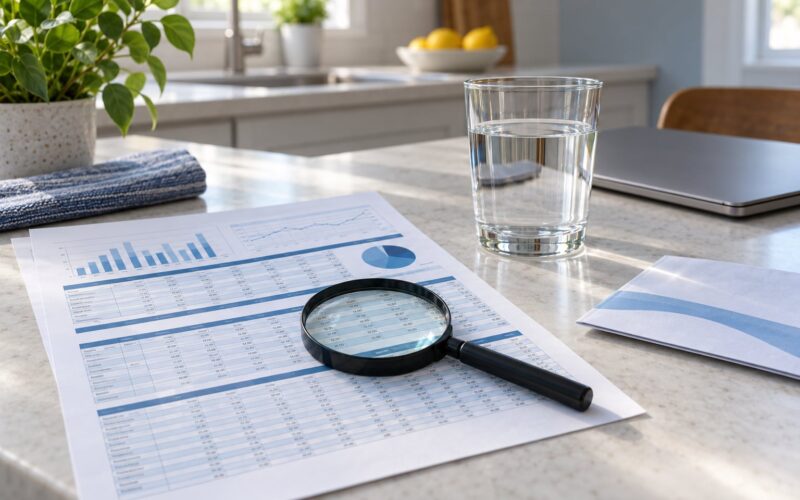
Both methods look the same on a shelf and both are sold with confident claims. A lab panel does not. For municipal supply, your utility publishes an annual Consumer Confidence Report, and it is a public document — homeowners in the forum threads describe opening it and admitting they cannot parse most of it.
Reading it is simpler than it looks. Find the table of detected contaminants, compare each value against the EPA maximum contaminant level, and note anything flagged as an exceedance or a detected level above zero. For a private well, there is no such document, and a certified lab panel is the only honest starting point.
Reverse Osmosis vs Carbon Filter: Cost, Maintenance, and Convenience
Cost follows complexity, so compare whole systems rather than sticker prices. A carbon setup is one appliance with one consumable. An RO setup is a membrane housing, pre-filters, a post-filter, a tank, a drain line, a feed valve and possibly a pump, each with its own interval.
Upfront, a carbon filter is the modest purchase and an under-sink RO installation is the larger one, with plumbing work often costing more than the hardware. Over five years the gap narrows and then inverts if you are buying bottled water: carbon still costs less in consumables, but neither system approaches the running cost of cases of bottled water for drinking and cooking.
Replacement schedule you can write on a calendar
Sediment pre-filters are commonly replaced every six to twelve months or whenever pressure at the faucet climbs noticeably. Carbon pre-filters usually run six to twelve months too, and shorter on a supply with heavy chloramine. Post-filters last roughly a year. The RO membrane itself is generally rated at two to three years, and the storage tank filter around the same interval.
Carbon-only households replace a single cartridge on a similar cycle. The difference is not really the frequency so much as the number of things to remember, and the fact that a neglected membrane fails quietly rather than loudly.
Flow rate, pressure and the cabinet
Reverse osmosis capacity is quoted in gallons per day, which tells you nothing unless you translate it. A tank system refills slowly after a glass or two, and the tank slowly refills in the background. Tankless models with a booster pump deliver on demand but take up space, make some audible pump noise and need a power outlet.
If you want to feed a seltzer machine or an ice maker, ask about pressure and flow requirements before anything else. Homeowners report being quoted standard under-sink systems and discovering the appliance simply will not work with them. Carbon filters sidestep all of this because they deliver at tap pressure, indefinitely, with no tank and no drain line.
Space is the other quiet constraint. Under-sink cabinets that already hold a disposal, a dishwasher supply, or a carbon dioxide cylinder for a soda machine leave very little room for a tank and three housings.
Reverse Osmosis vs Carbon Filter: Environmental Impact
On a site like this one, the water waste question deserves a straight answer rather than a footnote. Conventional reverse osmosis discards three gallons for every gallon produced, and that concentrate carries the rejected salts down the drain. It is not a catastrophic volume, but in a dry region it is water that has been treated twice and used once.
There is room to improve it. Modern membranes with higher recovery rates waste less than older designs. Storage tanks flush a small volume on each cycle to keep the membrane wet, and that flush can be adjusted or fitted with a tank flush valve. Collecting reject water for irrigation is possible but fiddly, and most households skip it.
Carbon filters waste no water at all, which is their one clear environmental advantage. Their footprint is the cartridge itself, most often a plastic housing with loose carbon media inside that is difficult to recycle and usually ends up in general waste.
Set that against what both filters replace. A household that moves from bottled water to either method avoids a meaningful stream of single-use plastic. For most families that single trade beats the reverse osmosis reject water several times over, even though the plastic saving is the same whichever method you pick.
Reverse osmosis does carry one energy cost that people forget: softener regeneration. Hard water interacts with RO membranes badly, so many households add a water softener, and ion exchange softening regenerates with salt and water on a schedule. Where water is genuinely hard, a softener plus carbon is often the more sensible pairing than softener plus reverse osmosis.
Which Should You Choose?
Choose carbon filtration when you are on a municipal supply that passes its own testing, your complaints are chlorine taste, odour and sediment, you want water that still tastes like water, and you would rather not think about it again for a year.
Choose reverse osmosis when you are on a private well, when a test has shown lead, nitrates, PFAS, arsenic or high total dissolved solids, when you have a lead service line, or when you simply want the broadest removal available and will accept the taste and the upkeep for it.
Choose neither until you know what you are treating. That is the most useful advice in this whole comparison, and it is the step people skip. A filter chosen to solve a problem that does not exist in your water is an expensive glass of water.
Four steps to the right choice
- Find out what is in your water. Read the Consumer Confidence Report from your utility, or order a lab panel for a well.
- List the contaminants you actually want removed. Chlorine and taste and odour are one decision. Nitrates, lead and dissolved solids are a different one.
- Match the method to the list. Dissolved contaminants point to reverse osmosis; chlorine, taste, odour and sediment point to carbon.
- Check the certification before you buy. A claim on the box means nothing without a third-party standard behind it.
What the NSF/ANSI numbers actually certify
NSF/ANSI 42 covers aesthetic effects — taste, odour and particulate reduction. It is the weakest of the four and tells you nothing about health contaminants. NSF/ANSI 53 covers health-related contaminants such as lead, cryptosporidium and cysts. NSF/ANSI 58 covers reverse osmosis specifically, including TDS reduction. NSF/ANSI 401 covers emerging contaminants, and PFAS falls under this one.
A cartridge certified only to 42 is a taste product. A household worried about lead wants 53. A household filtering for PFAS wants 401 with the compound named. No competitor on this topic explains that distinction, and it is the fastest way to tell a serious product from a marketing claim.
How to read your water quality report
Open the Consumer Confidence Report and go to the detections table rather than the compliance summary. Compliance only tells you whether the utility met legal limits; detections tell you what is actually in the water. Note the levels for nitrate, lead, arsenic and any disinfection byproducts, then note the water source and treatment described in the report’s opening pages.
If something is flagged, do not diagnose from the report alone. A single elevated result in one sampling round means the level was measured once. For anything concerning, a follow-up test at your own tap, through a properly flushed sample, is more informative than the utility’s compliance data.
For a private well, test at least annually and after any flood or heavy rain. That is CDC guidance, and it is the one recommendation here that matters more than the choice between filters.
Frequently Asked Questions
Is reverse osmosis better than a carbon filter for drinking water?
No single method is always better. Reverse osmosis is generally stronger against dissolved salts, metals and many industrial contaminants, while carbon filters are usually more suitable for chlorine, sediment, taste and odour. On a well-run municipal supply, carbon is often enough; on a well or with known lead, nitrate or PFAS, reverse osmosis earns its extra cost.
Can a carbon filter remove PFAS or lead?
Some certified carbon filters can reduce certain PFAS compounds or lead, but performance varies widely by model and cartridge condition. Check for NSF/ANSI 401 for PFAS or NSF/ANSI 53 for lead, and confirm the exact contaminant named on the certification. Standard carbon media that is not certified for these compounds should not be relied on.
Does reverse osmosis remove bacteria and viruses?
Reverse osmosis membranes reduce a very high percentage of microorganisms, but water should not be considered safe solely because it passed through a system. A private well that has tested positive for coliform needs proper disinfection and professional treatment, not a drinking-water filter. Certification to NSF/ANSI 58 addresses the system, not the condition of your source.
Is reverse osmosis water bad for you because it removes minerals?
For most people, drinking water does not supply substantial nutrition, and properly maintained reverse osmosis water is generally considered suitable to drink. The concern is usually raised as being hard on the kidneys, which is a framing issue rather than an established risk. A remineralisation cartridge or a mineral-rich diet covers the intake. People with specific medical conditions should ask their doctor.
How often do reverse osmosis systems and carbon filters need replacing?
Sediment and carbon pre-filters are commonly replaced every six to twelve months, a carbon post-filter roughly annually, and the reverse osmosis membrane every two to three years. A carbon-only household replaces a single cartridge on a similar cycle. Note that cartridges degrade quietly rather than visibly, so calendar reminders work better than waiting for a change in taste.
What are the downsides of using a carbon water filter?
A carbon filter does nothing about dissolved solids, nitrates, fluoride or most heavy metals, and it cannot remove bacteria or viruses. Its media saturates on a schedule and filtration then declines without warning. Run past the replacement interval and the water may taste acceptable while no longer being treated as certified.
Final Recommendation
Start by finding out what is in your water. Pull the Consumer Confidence Report from your utility, or order a lab panel if you are on a well, and write down the contaminants you actually want removed. Everything else is a preference you can settle later.
Then match the method to that list. Dissolved contaminants, a well, or a lead service line point to reverse osmosis. Chlorine, sediment, taste and odour point to carbon, and on good municipal water that is genuinely sufficient. If the water chemistry is unclear or you want both breadth and better flavour, stage it: whole-home carbon for taste, point-of-use reverse osmosis for drinking and cooking.
Whichever you pick, check for NSF/ANSI 53 or 58 rather than 42, put the replacement dates in your calendar, and measure what matters most in this comparison — contaminant removal, water wasted and money spent over five years, not the number printed on the box.