Cutting your household water use in half is realistic for most homes, and it comes down to four things: leaks, high-flow fixtures, outdoor irrigation and daily habits. Budget one afternoon for the audit and repairs, then a month of meter readings to prove the number moved. Here is the plan, with the litres each step actually saves.
I want to be straight about the arithmetic before we start. Halving total use is harder than halving indoor use, because outdoor irrigation can be a third of everything a home consumes. Homes that cut outdoor use aggressively and fix leaks almost always get there. Homes with a large garden and no irrigation changes usually land around 25 to 35 percent.
Table of Contents
- What You Need
- Step-by-Step: How to Cut Household Water Use in Half
- Step 1: Measure Your Current Household Water Use
- Step 2: Find and Fix Leaks and Running Toilets
- Step 3: Reduce the Water Used in the Toilet
- Step 4: Install Efficient Shower and Bath Fixtures
- Step 5: Make Laundry and Dishwashing More Efficient
- Step 6: Cut Outdoor and Garden Water Waste
- Step 7: Change Everyday Household Habits
- Step 8: Track Your Progress and Prove You Cut Household Water Use in Half
- Common Mistakes
- Frequently Asked Questions
- Is 500 litres of water usage a day a lot?
- What wastes the most water in a house?
- How many gallons can a leaky toilet waste in a month?
- How many litres does a normal shower use?
- Does flushing a toilet make your water bill high?
- Do rain shower heads use a lot of water?
- Start With the Biggest Source of Waste
What You Need
You need very little, and most of it costs nothing. The important part is paper: your meter reading and your last few bills, because a sudden jump is the single strongest clue that something is leaking.
- Your water meter location and a notebook or phone note to record readings on the same day each month.
- A measuring jug or large cup (a 2-litre bottle works) for flow-rate tests.
- A bucket for the shower cold-start catch and for catching drips.
- A torch or flashlight for under-sink and behind-toilet checks.
- Dye test tablets, or a few drops of food colouring for the toilet flapper test.
- An adjustable wrench and a flathead screwdriver for aerators and flapper adjustments.
- A stopwatch for timing showers and filling the bucket test.
Before any plumbing work, check whether your fixtures have a water-efficiency label equivalent to EPA WaterSense. In Europe the A+ water label used in France and Spain carries a different scoring system, but it does the same job: it confirms flow rate in litres per minute rather than trusting a marketing claim.
Step-by-Step: How to Cut Household Water Use in Half
Step 1: Measure Your Current Household Water Use
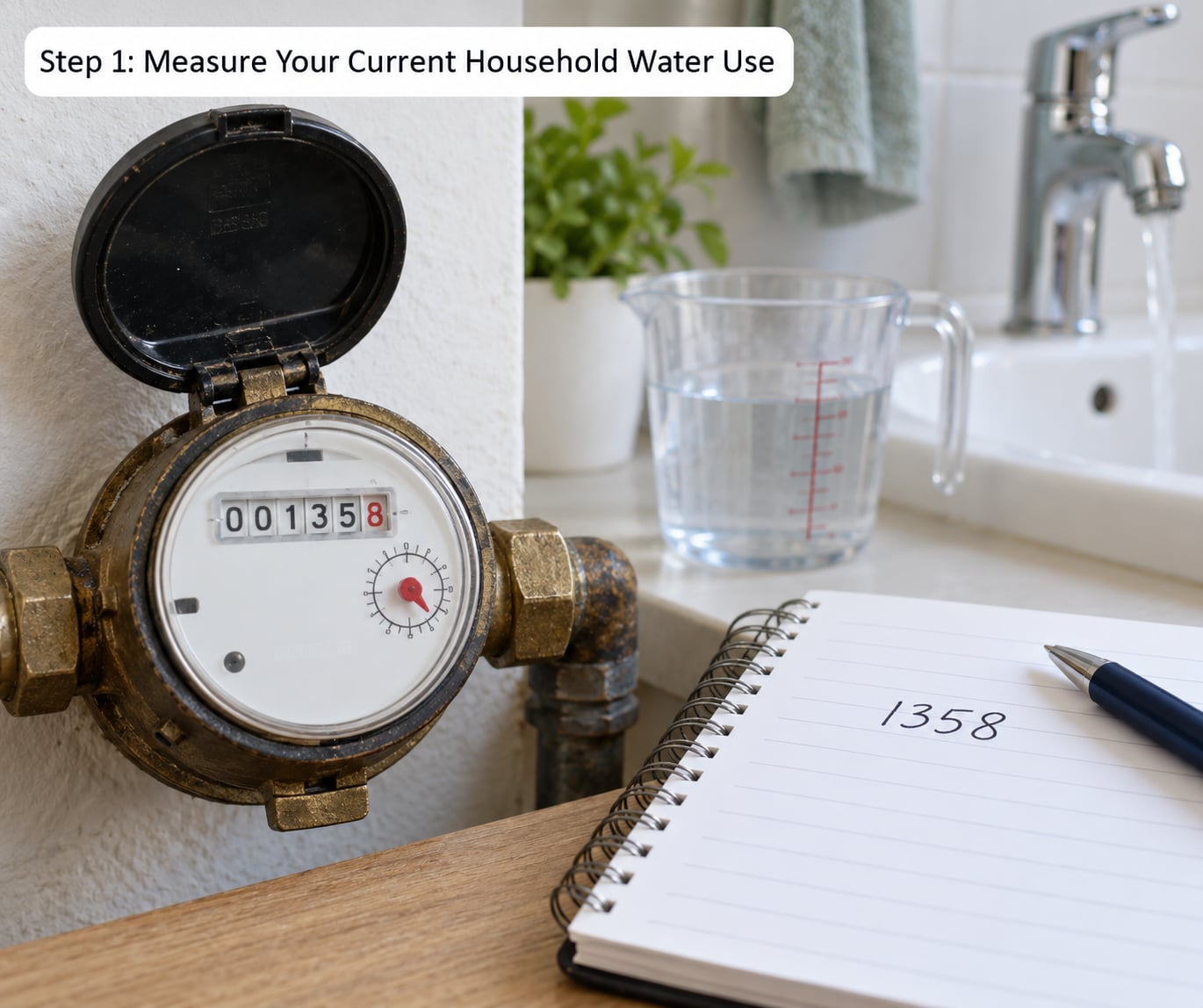
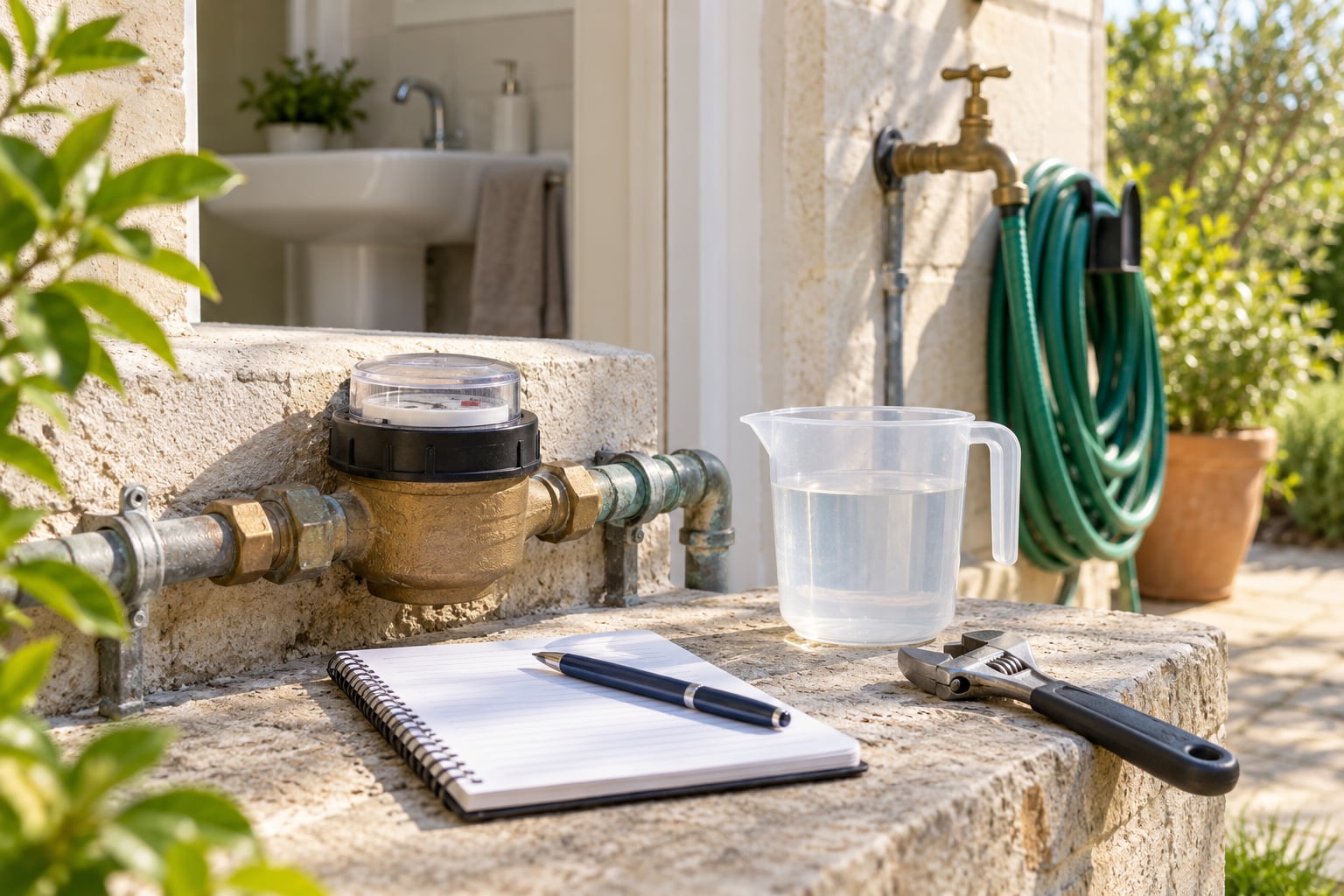
You cannot halve a number you have never measured. Find the meter, usually outside by the boundary wall or in a utility cupboard, and read it at the same hour on the same day for a month.
Here is how to read it. Most meters have a black dial, a row of black digits and a row of red digits. The black digits are whole cubic metres, the red ones are fractions. If your meter counts in gallons, the dial and digits work the same way. Write down the number, the date, and how many people lived in the house during that period.
Then divide. Multiply the difference between two readings by 1,000 to get litres used in that period, and divide by the number of days. A US household averages around 1,100 litres (300 gallons) a day for about 2.6 people, which works out near 135 litres per person per day. European households commonly sit closer to 100 litres per person per day, so if you read well below that you already have room to cut.
Is 500 litres a day a lot? For a two-person household, yes, that is roughly double a comfortable average and usually points to an outdoor leak, an old toilet or a long daily shower habit.
Here is roughly where the water goes in an average home, using typical EPA WaterSense figures. Outdoor use is measured as a share of total, the rest as a share of indoor use.
| End use | Share of use | Typical volume |
|---|---|---|
| Toilets | About 24 percent of indoor | 6 litres per flush on an older model, 3 to 4 litres on a modern one |
| Showering and bathing | About 17 percent of indoor | 38 litres for a 5-minute shower at 7.6 litres per minute |
| Faucets | About 12 percent of indoor | 6 litres a minute at a typical bathroom tap |
| Washing machine | About 22 percent of indoor | Around 150 litres a full load |
| Dishwasher | About 6 percent of indoor | 15 to 25 litres a cycle on an efficient model |
| Leaks | About 12 percent of indoor | A running toilet can reach 750 litres a day |
| Garden and outdoor | About 30 percent of total | The single largest block for most suburban homes |
Set your target as half of your measured number, not half of a national average. Write it on the same notebook page as the first reading so you compare against your own home.
Step 2: Find and Fix Leaks and Running Toilets
Leaks are the fastest saving available, and on older plumbing they can account for an eighth of all indoor use. Start with the toilet, because a leaking flapper is the most common and the most easily missed fault in a house.
The dye test takes two minutes. Put dye tablets in the tank, flush once, then wait ten minutes and look in the bowl. Any colour in the bowl means water is passing the flapper, and you have a leak. Put a sheet of kitchen paper in the bowl, flush, and check the paper for a damp mark. A flapper that has warped, or a fill valve that never shuts off, is a five-minute DIY job or a quick plumber call.
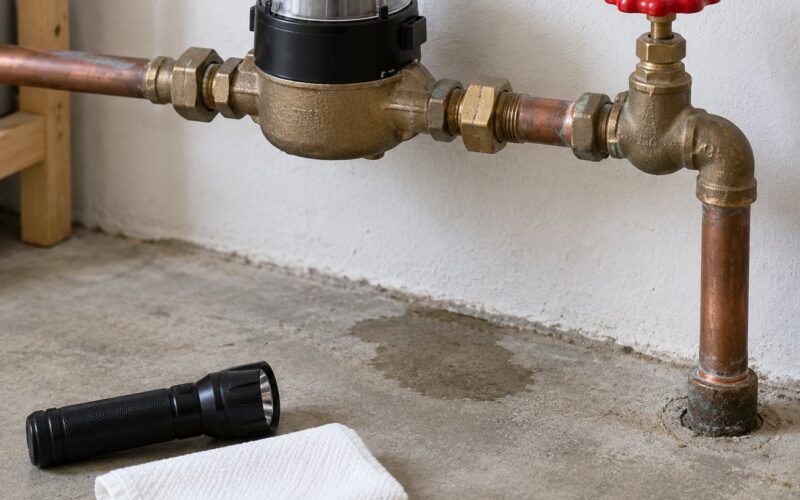
For the whole house, read the meter at night when everything is off. If the meter is still moving in the morning, water is coming from somewhere you cannot see. In a rented flat that is a landlord conversation, and you can show them the meter photo and the two readings.
Check the obvious rest too. Listen for water running when nothing is in use, look under every sink for a damp cabinet floor, and inspect washing machine hoses for bulges. A tap dripping steadily wastes roughly 30 litres a day, about 1,100 litres a year, and it is the easiest repair on this list if you want to practise with a wrench.
Outside, run each irrigation zone by hand and watch where the water goes. A cracked riser spraying into the path and a broken sprinkler head aimed at the pavement are common in dry climates, and both waste entire zones.
Step 3: Reduce the Water Used in the Toilet
Toilets are the largest indoor use, so this is where the biggest indoor saving sits. Most Spanish and European homes still carry 6-litre cisterns from the 1980s and 90s, while modern efficient models flush 3 to 4 litres and dual-flush units give you 3 litres for solids and 1.5 for liquids.
Adjust before you replace. The flush lever or rod can often be shortened slightly so the flapper closes sooner, which alone can drop a 6-litre flush to 4 or 5 litres. A dual-flush retrofit fits inside most existing cisterns and costs far less than replacing the whole toilet, which is the right move if your pan and cistern are in good condition.
Flushes you skip do count. Roughly a third of home bathroom water use is people flushing with urine rather than waste. That is the behaviour that actually makes a difference, and it takes a conscious week or two to build.
If you want to keep the flush frequency and cut litres instead, a bottle of water in the cistern is the traditional poor-man’s trick, and it works but looks improvised. A properly sized dual-flush unit does the same job cleanly.
Step 4: Install Efficient Shower and Bath Fixtures
A shower is the second biggest indoor use, and the fix is a flow rate, not a shorter shower. A standard showerhead delivers about 9.5 litres per minute (2.5 gallons per minute), so eight minutes uses around 75 litres. An efficient showerhead at 7.6 litres per minute (2.0 gallons per minute) or below cuts the same shower to about 60 litres, and a good one at 6 litres per minute brings it to 48.
The argument that low-flow showerheads backfire because people shower longer is real but small in practice. Studies and utility data consistently show net savings, and most of the shower time in a household is thinking, not standing under water.
Measure your current flow rate before buying. Put the measuring jug under the shower, run it for ten seconds, multiply by six, and you have litres per minute. Do the same at the bathroom and kitchen taps. If a bathroom tap delivers 6 litres per minute, a 1.5 litres per minute aerator cuts the volume by three quarters and usually improves the spray feel rather than making it worse.
Bath tubs are the other half of this step. A tub holds 150 to 200 litres, so a weekly bath replaces nearly ten showers. For most homes the honest trade is fewer baths and showers that do the same job in five minutes.
When a job means cutting into the pipework behind a wall, call a licensed plumber. Aerators, showerheads and flapper adjustments are ordinary DIY work with the owner’s manual open; anything behind tile is not.
Step 5: Make Laundry and Dishwashing More Efficient
Appliances waste very little when loaded properly and a great deal when half-empty. Washing machines use close to the same water whether the drum is full or three-quarters full, because the cycle is fixed. Running full loads only is the easiest saving here.
Clean the lint filter and the dishwasher filter on the schedule in the manual. A clogged dishwasher spray arm and a dirty filter push a cycle to run longer, and longer means extra water at the rinse stage.
Dishwashing is the most argued comparison online, so the numbers settle it. Washing a full load of dishes by hand under a running tap typically takes 40 to 60 litres. A modern efficient dishwasher uses about 15 to 25 litres per full cycle, and a bowl method of rinsing once and stacking cuts the hand-washing figure to under 10 litres. Full loads are the condition attached to that comparison, and scraping rather than rinsing is where most people lose the water.
For laundry, wash at 30 degrees where the fabric label allows it, use the eco or short cycle, and skip the extra rinse. Front-loading machines are more efficient than top-loaders with a central agitator, which matters if you are replacing one eventually.
Step 6: Cut Outdoor and Garden Water Waste
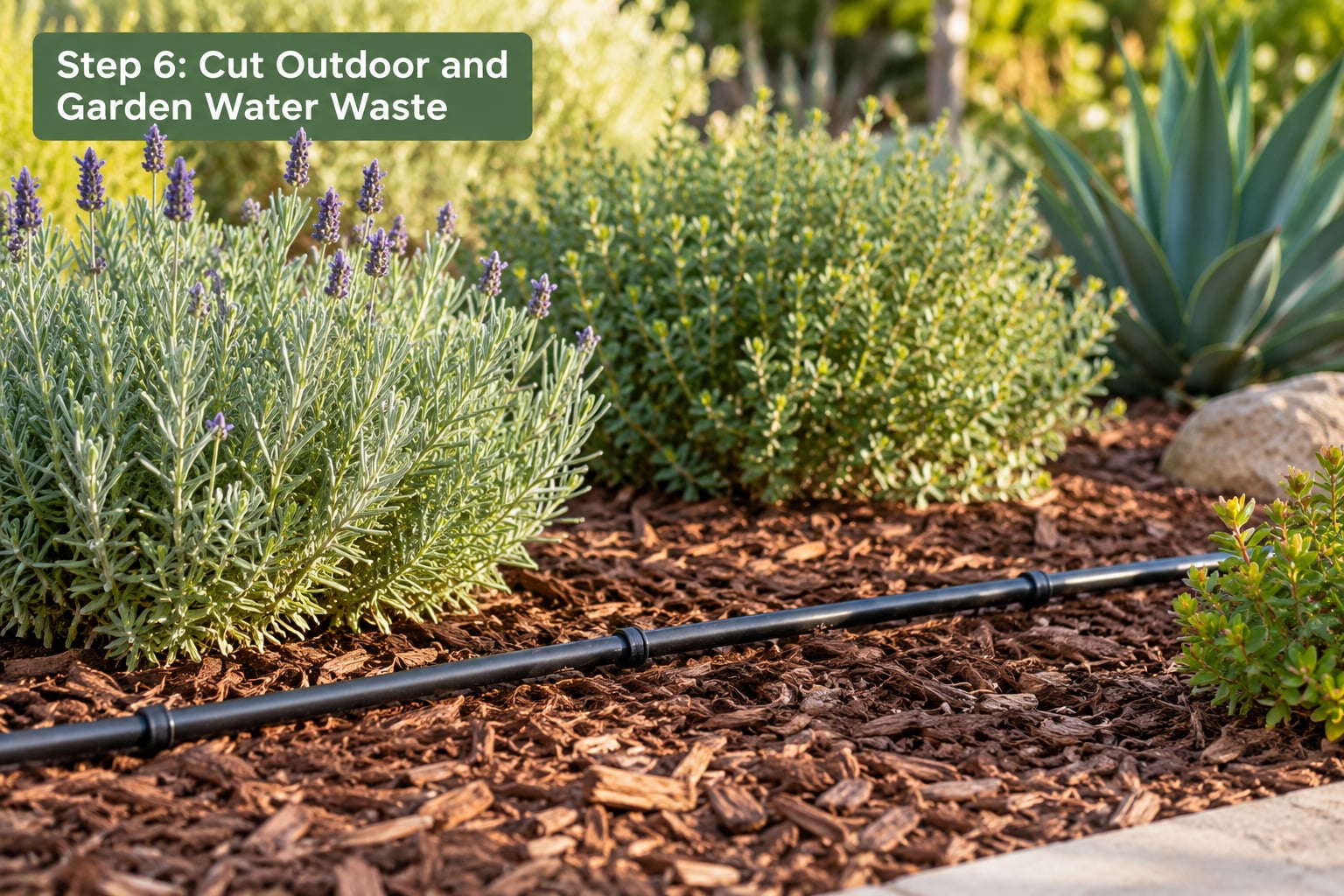
Outdoor use is where halving becomes easy or impossible, because a sprinkler running on a timer in July can outweigh every indoor fix combined. In Andalusia’s dry summers, drought contingency plans routinely restrict irrigation to certain hours, and working with those restrictions is simpler than fighting them.
Water early in the morning, never at midday. Wind and heat loss to evaporation can waste a third of what a sprinkler delivers in the middle of a hot afternoon, which is pure loss for you and for the reservoir.
Switch to drip irrigation or a soaker hose. Sprinklers throw water into the air where it drifts and evaporates; a drip line puts water at the root zone where the plant can take it up. A soil moisture sensor or a smart irrigation controller that skips a cycle after rain pays for itself over a few summers.
Add 5 to 7 centimetres of mulch over bed soil and check moisture a finger’s depth down before watering at all. Many gardens are watered on a timer rather than on need, and that is the reason the timer itself is worth auditing. Replacing thirsty lawn and bedding with drought-resistant plants removes the demand instead of managing it.
Collecting rainwater from a downspout into a rain barrel is straightforward where local rules permit, and rules vary by municipality, so check yours first. Note that in some Andalusian towns rainwater collection for potable use is restricted while irrigation use is allowed. Greywater from shower and basin outlets to flush a toilet works technically, but it needs a permit and a proper design, and it is not a weekend job.
Step 7: Change Everyday Household Habits
Habits save less than people expect and more than people admit, because they are the only savings that keep happening after month one. Turn the tap off while brushing teeth and it stays off for two minutes twice a day, which is around 12 litres per person per day across a household.
Fill a basin rather than letting a tap run while you wash your hands, and take the shorter shower first so nobody waits behind you. The cold-start bucket trick is worth naming because the internet mocks it unfairly: catching the cold water that runs while the shower heats up saves 2 to 5 litres per shower, which is 8 to 20 litres a person a month if you shower daily. That is small next to a low-flow head, and it is genuinely free.
For dishes, scrape instead of rinsing. For car washing, a bucket with a shut-off nozzle beats a running hose by a wide margin, and washing on the same spot you already rinsed with a bowl of water saves the pavement too.
Get the rest of the household on board, because one person running the dishwasher while another starts a second load wastes the saving. A note on the fridge works better than a conversation.
Step 8: Track Your Progress and Prove You Cut Household Water Use in Half
Take a second reading on the same day of the month you took the first. The difference, in litres, divided by the days in the period, is your new daily use. Compare that to the old daily use and you have your percentage cut.
If you came in 20 percent short, work out which step missed. My rule is to recheck the meter for an overnight leak first, because a silent leak will hide every other improvement you made.
People revert around week five, when the novelty wears off and the shower runs long again. Three things keep it going: keep reading the meter monthly even after you hit the target, put the new showerhead timer or the tap-off habit where everyone can see it, and re-test the toilet with dye twice a year, since flappers stiffen as they age.
Common Mistakes
The most common mistakes are buying fixtures without checking flow rate, ignoring hidden leaks, overwatering gardens, treating water-saving devices as a substitute for good habits, and measuring a single day. Here are the rest, each with the fix.
- Buying a showerhead without checking litres per minute. Many models advertise low flow but sit at 9.5 litres per minute. Check the labelled flow rate first, or measure yours as above and shop for that number.
- Assuming a quiet toilet is leak-free. A leaking flapper can hiss below audibility. Dye test twice a year.
- Measuring one day and calling it a baseline. Laundry days and garden days swing weekly. Use a full month before you judge.
- Watering the garden on a timer nobody reviewed. Set the schedule from soil checks, and shorten it after rain.
- Treating a water-saving device as the whole job. An efficient toilet in a home with a running toilet and a nightly sprinkler saves nothing you can see on the bill.
- Ignoring hoses and irrigation lines. Washing machine hoses and outdoor dripline are the two most common hidden leaks, and both fail suddenly.
- Pre-rinsing dishes. Scrape, stack, and run the dishwasher full. This alone can halve a household’s dish water.
- Forgetting appliances that use water invisibly. Water softeners, continuous-feed humidifiers and evaporative coolers all draw water on a schedule you never think about.
- Skipping aerators in hard-water areas. Limescale clogs aerators within months and quietly raises flow. Clean them, and check whether you are losing pressure to scale rather than to a faulty head.
- Assuming tenants cannot do anything. Renters can still dye test, aerator-swap, showerhead-swap, measure the meter, fix drips, and report a leak with evidence.
Frequently Asked Questions
Is 500 litres of water usage a day a lot?
Yes, for most households. A home of two people using 500 litres a day is roughly double the European average of about 100 litres per person per day. It usually means one of three things: an old 6-litre toilet flushing many times a day, a shower running far longer than you think, or an outdoor leak or irrigation timer nobody adjusted. Read your meter for a full month to confirm the figure, then run the dye test on the toilet first.
What wastes the most water in a house?
Toilets are the largest indoor use, at roughly 24 percent of indoor volume, and outdoor irrigation is often around 30 percent of total use in a home with a garden. After that come showers, the washing machine, taps and leaks. Leaks sit at roughly 12 percent of indoor use, which is why fixing them is the quickest win on any list.
How many gallons can a leaky toilet waste in a month?
A toilet with a failing flapper can waste nearly 750 litres (200 gallons) a day, which is more than 22,000 litres (6,000 gallons) in a month. That single fault will put most households into the top range of water use without anybody noticing. A dye test in the tank costs a minute and finds it immediately.
How many litres does a normal shower use?
A standard showerhead at 9.5 litres per minute running for eight minutes uses about 75 litres. At 7.6 litres per minute the same shower uses roughly 60 litres, and at 6 litres per minute about 48 litres. Cutting to five minutes on an efficient head typically brings a daily shower from around 75 litres to under 40 litres.
Does flushing a toilet make your water bill high?
Only if the toilet is old or leaking. An older 6-litre cistern at five flushes per person per day uses 30 litres per person daily, which for three people is 90 litres a day. A modern 3-to-4-litre or dual-flush unit cuts that to under 15 litres per person, and fixing a leaking flapper removes waste that is pure loss.
Do rain shower heads use a lot of water?
A rain head alone can use more than a standard showerhead, because many deliver 12 litres per minute or more. Water use depends entirely on the labelled flow rate, not on the spray pattern. Choose a rain head rated at 7.6 litres per minute or below, or pair a wider head with an eco setting and a shorter shower, and you will cut volume rather than increase it.
Start With the Biggest Source of Waste
Start with the meter, then with the leak test, because those two steps cost nothing and tell you where your water actually goes. Fix anything leaking before you buy a single fixture.
After that, work the largest blocks in order: outdoor irrigation first if you have a garden, then the toilet, then shower and tap flow rates, then laundry and dishwashing habits. That sequence is how to cut household water use in half in practice rather than in theory, and it is worth adding the everyday habit changes last, because they cost nothing and they are the reason the savings survive past the first month.
A three-person household sitting at about 330 litres a day can realistically reach 160 litres a day by fixing leaks, swapping to a dual-flush toilet and an efficient showerhead, running appliances full, and halving a nightly sprinkler schedule. Read your meter again on the same day next month, and you will know within a year whether you did.
Last updated: 2026