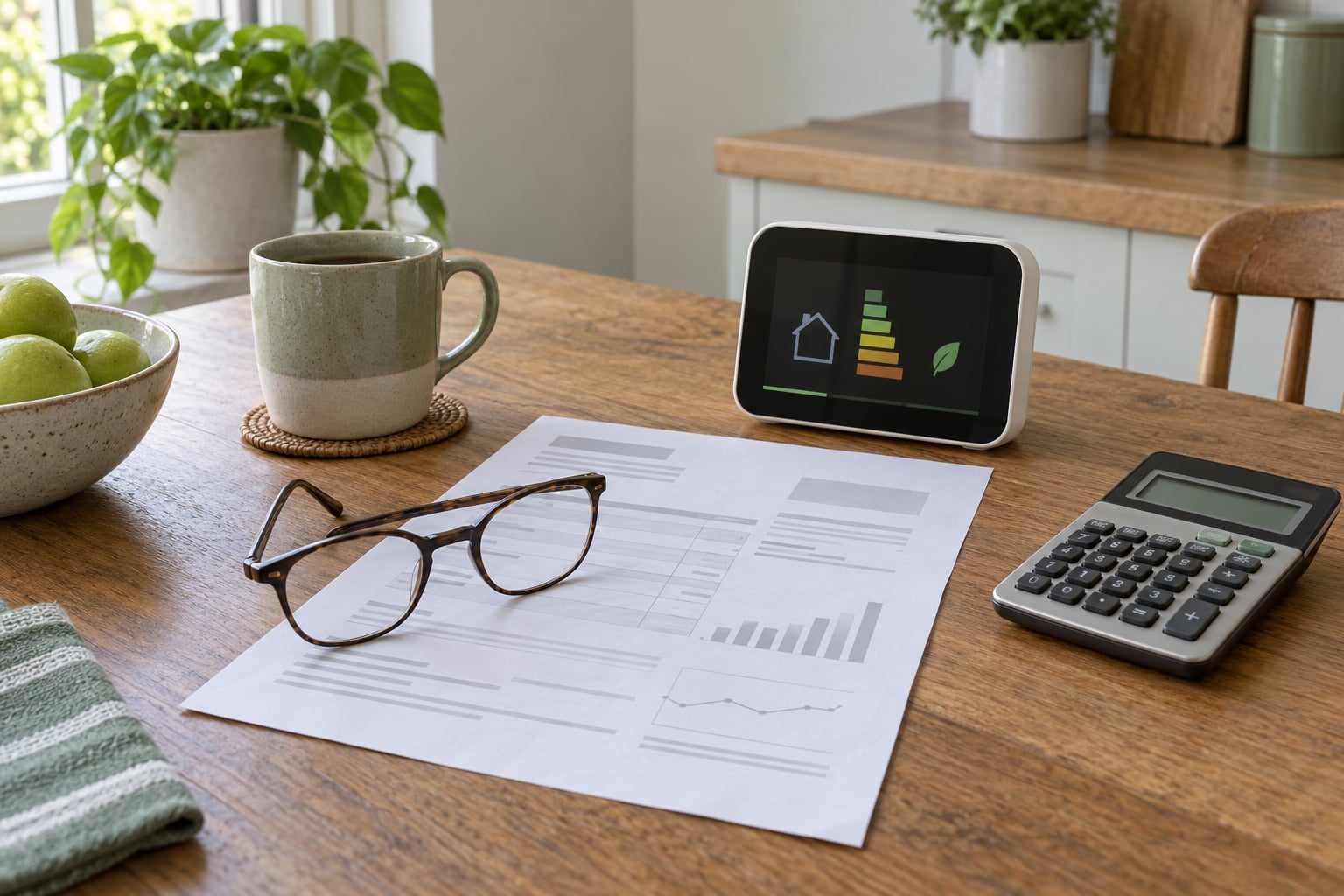
A kilowatt-hour (kWh) is the unit your electricity is billed in: the energy used by running a 1,000-watt appliance for one hour. To read your electricity bill and understand kWh charges, take the meter difference, multiply it by the unit rate, then add the fixed charges and taxes until you reach the amount due.
That is the whole job. You are not touching wiring or opening anything — the bill tells you almost everything if you know which line to look at first. Ten minutes with your last two bills and a calculator is usually enough to tell whether the number is fair.
One warning before we start: rate structures differ by country, state, utility and plan, so treat the numbers below as worked examples rather than what you should pay. The method is what transfers.
Table of Contents
- What You Need
- Step-by-Step: How to Read Your Electricity Bill and Understand kWh Charges
- 1. Confirm the billing period and account details
- 2. Check whether the reading is actual, estimated, or adjusted
- 3. Find your consumption in kWh
- 4. Identify the unit rate and tariff type
- 5. Verify the energy charge with a worked example
- 6. Reconcile every line before the total
- What a normal bill looks like
- Common Mistakes
- Frequently Asked Questions
- Why does my electricity bill use an estimated kWh reading?
- How many kWh is a high electricity bill for a household?
- Is a watt the same as a kWh on an electricity bill?
- How do solar export credits appear on an electricity bill?
- What should I check before disputing a kWh charge?
- Why is my delivery charge so high on my electric bill?
- Conclusion: Start With Your Meter Reading and Unit Rate
What You Need
To do this properly, gather four things before you start:
- The current bill. Ideally the PDF or the full itemised statement, not a notification email with only a total.
- The previous bill. You need the previous meter reading from it, so dig it out of the folder or the supplier’s archive.
- Your meter reading. Either the number on the meter itself, a smart meter in-home display, or the reading your supplier shows in the app.
- A calculator and your tariff details. Unit rate, tariff name, and whether you are on a fixed, variable or time-of-use price.
That is the full kit. If you want the meter number directly, read it through the glass or from the app rather than opening any panel — meters are sealed and any physical work on the supply belongs to a licensed electrician, following the manufacturer’s instructions.
Step-by-Step: How to Read Your Electricity Bill and Understand kWh Charges
1. Confirm the billing period and account details
Start at the top of the statement and check five fields: your customer or account reference, the supply address, the meter number, the billing period start and end dates, and the total amount due.
Also confirm what kind of document you are holding. A bill is based on a real meter reading. An estimate is based on an average or a previous read. A corrected invoice has been reissued after an error. The label usually sits near the total or in the messages section.
If the supply address or account number is not yours, stop and query it before paying. Misdirected bills happen when homes change hands or meters are swapped.
2. Check whether the reading is actual, estimated, or adjusted
Look for the words actual, meter read, or estimate beside the reading. An actual read means someone or a smart meter captured the number. An estimate means the supplier filled it in.
Estimates are normal in remote or hard-to-access areas, at properties where a smart meter has not been installed, and after a new account opens. They also occur after a long holiday when nothing in the house registers a change in consumption. The problem is not the estimate itself but that the estimate carries no information about what you actually used.
If the meter number printed on the bill does not match the one on your meter, that is worth a query. So is a corrected invoice whose kWh figure differs sharply from the corrected one. Ask your supplier for the read type and the meter serial before you assume a mistake, because a mismatch often turns out to be a data-entry slip rather than a wrong charge.
3. Find your consumption in kWh
Your consumption is the difference between this billing period’s meter reading and the previous one. Subtract the earlier number from the later number, and the result is the kWh you were billed for.
Worked example: this bill shows a present reading of 4,850 and a previous reading of 4,500. The difference is 350 kWh for the period. That is the figure that matters, not the meter number itself, because a meter is a running total that never resets.
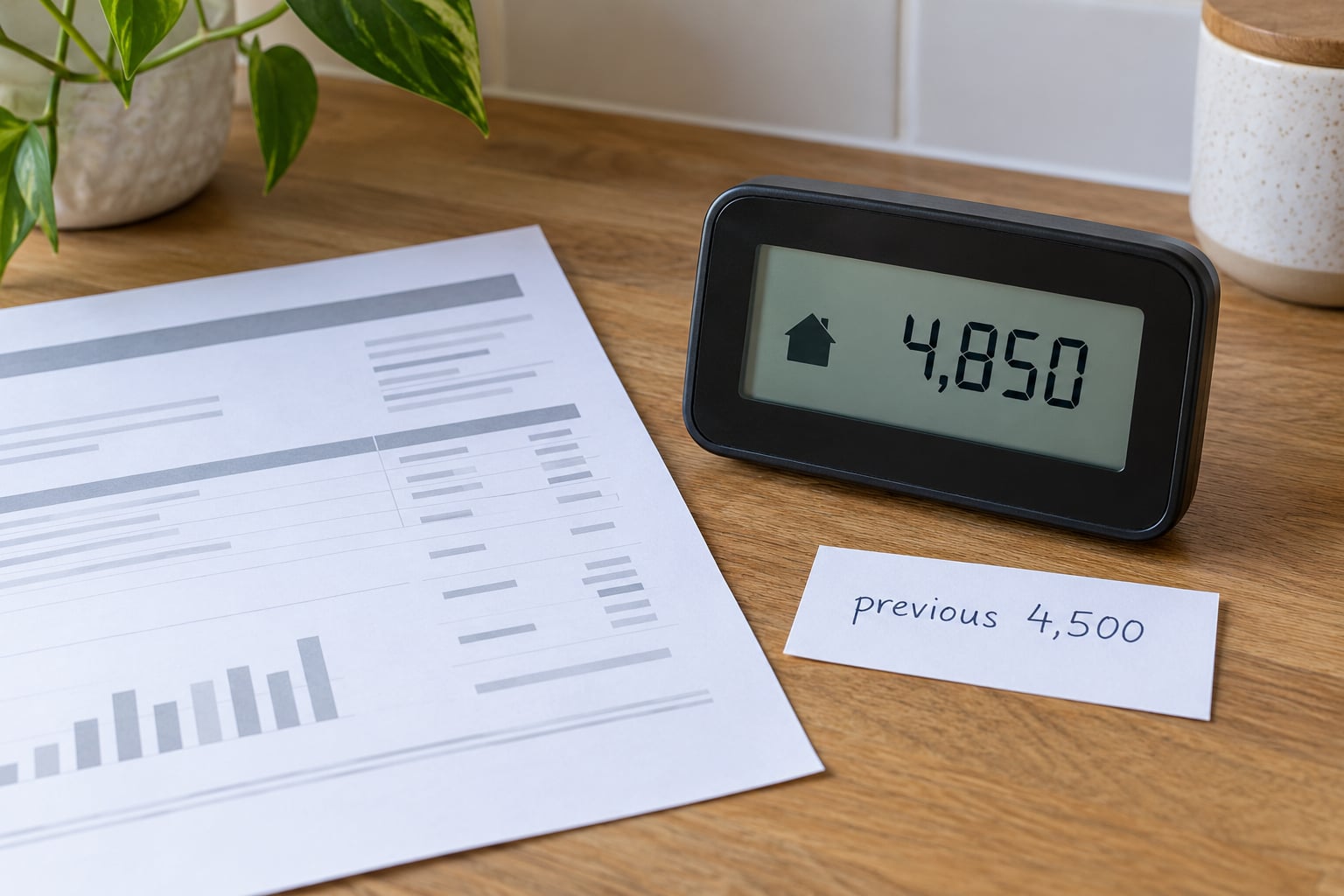
Many statements also print a usage history graph. Read it as a shape rather than exact figures: a short winter column next to a tall summer one is normal in a climate with air conditioning or heating, and it tells you which months drive your annual cost.
4. Identify the unit rate and tariff type
The unit rate is the price per kilowatt-hour, usually printed in cents per kWh. Find it on the summary block, near the energy charge line, or in the tariff schedule your supplier published.
Three tariff types change how that rate applies:
- Fixed rate. The same price per kWh all period, whichever time you use it.
- Variable rate. The price follows wholesale market conditions and changes month to month.
- Time-of-use. Different unit rates apply to peak, shoulder and off-peak windows, and your bill shows a separate kWh line for each window.
Check whether a discount, promotional rate or special plan applies to this bill and what period it covers. This matters because some headline rates expire or step up after a set number of months, and the rate you saw when you signed up is not necessarily the rate on the statement in front of you.
5. Verify the energy charge with a worked example
The energy charge is billed kWh multiplied by the unit rate. Taking the 350 kWh from step 3 at a rate of 18.5 cents per kWh: 350 multiplied by 18.5 gives 6,475 cents.
That single multiplication should match the energy charge line on your bill to the cent. If it does not, the reason is usually a time-of-use split (several windows added together), a meter multiplier, a discount applied after the multiplication, or a rate that differs from the one you expected.
Meter multipliers are worth a second look. In buildings where one meter serves several units, or on older master-metered properties, the meter counts a shared total and a multiplier converts it to your own consumption. A multiplier of 40 on a raw reading of 8.75 kWh becomes 350 kWh billed.
6. Reconcile every line before the total
Read from the energy charge down, separating the categories. You are looking for four groups, and they behave differently.
The supply or generation charge covers the power itself and the cost of producing it. The delivery or distribution charge covers the poles, wires, meter and the local network that carries the power to your door, and it is usually billed per kWh as well. Then come the fixed charges, such as the customer or base charge, which apply whether you use any electricity at all. Finally, taxes, levies and riders sit on top, often calculated on the energy charge alone rather than on the whole bill.
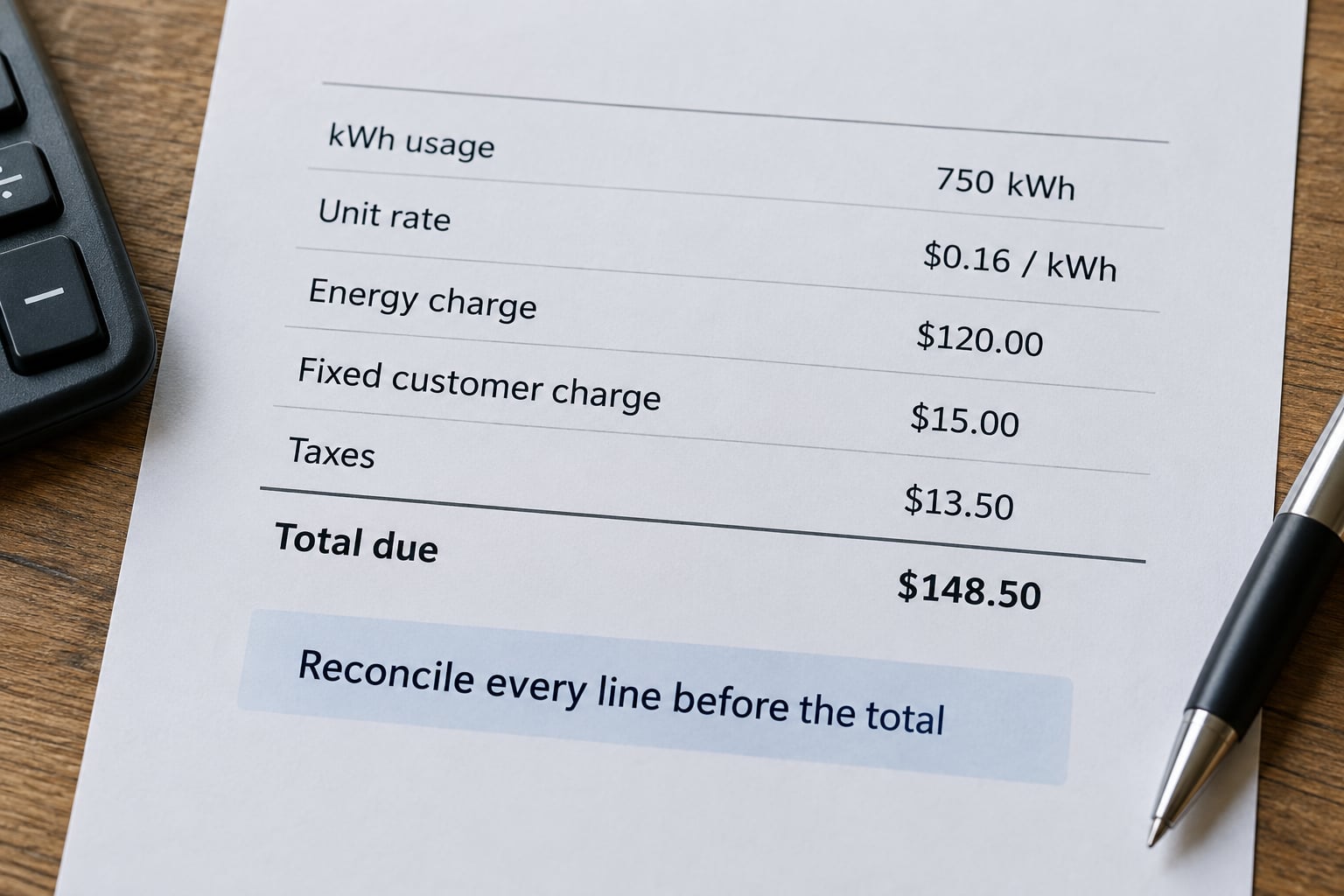
Carry the same example through. Add a fixed customer charge of 1,250 cents and taxes and riders of 1,150 cents to the 6,475 cent energy charge, and the sum is 8,875 cents. That should equal the total amount due before any account credit, direct debit or prior balance.
If you have solar, look for export lines. Under net metering your exported kWh offset imported kWh and the bill nets out. Under net billing your exports are credited at a lower, contracted rate, so you may see an export kWh figure with a separate monetary credit that never reduces the energy charge line. Credits appear as a negative amount, a separate credit line, or an accumulated balance carried forward.
What a normal bill looks like
It helps to have a benchmark. In the United States, the EIA reports an average residential consumption of roughly 900 kWh per month, around 29 to 30 kWh per day, or just over 10,800 kWh a year, at an average retail rate in the region of 18 cents per kWh.
So a three-person home in a temperate climate might land around 600 kWh a month, while an older home with electric resistance heating and several people home all day can sit well above 1,200 kWh. Forum discussions about bills are more useful when people compare kWh totals rather than amounts, because the unit cost varies so much between regions.
Common Mistakes
Treating kWh as money. A kilowatt-hour is a quantity of energy, not a charge. The bill is only finished when you apply a rate. Comparing your consumption across months means comparing kWh; comparing what you pay across regions means comparing the full effective rate per kWh, including fees.
Using the wrong period length. A three-month statement divided by three gives you a monthly average, but a summer quarter and a winter quarter are not comparable. Compare like with like when you are benchmarking.
Comparing meters that do not line up. Reading the display on the meter itself while the bill is based on a master meter with a multiplier will produce a number that looks wrong. Check for a multiplier before you query the bill.
Ignoring the tariff discount. A credit or discount line can be worth more than a small reduction in the unit rate, and it often lapses silently. If your total is higher than expected, check whether a promotion ended.
Assuming every tax is an energy charge. Some levies are calculated per kWh and others on the dollar amount of supply. Conflating them makes it impossible to tell whether a price change came from rates or from the tax structure.
Requesting a meter replacement before querying the read. Swapping a meter is slow, and most estimated-read disputes are settled by confirming the read type and the actual reading. Ask for that first, in writing, and keep the reference number.
Frequently Asked Questions
Why does my electricity bill use an estimated kWh reading?
Suppliers estimate when no one has physically read the meter or when a smart meter has not transmitted data. Common triggers include remote locations, long holidays when consumption barely moves, and new accounts with no previous reading. An estimate is not automatically wrong, but it carries no real usage information. You can ask for the read type, the estimated basis and a later actual read to settle the difference.
How many kWh is a high electricity bill for a household?
The EIA puts average US residential consumption at about 900 kWh per month, roughly 29 to 30 kWh per day. Consistently going above that without a known cause, such as electric heat, a home office or a new appliance, is worth investigating. Compare your own month against month rather than against someone else, since climate, floor area and occupancy change the number a great deal.
Is a watt the same as a kWh on an electricity bill?
No. A watt measures power, meaning how fast energy is used. A kilowatt-hour measures energy used over time. One kWh is what a 1,000-watt appliance consumes in an hour, so the formula is kWh equals watts multiplied by hours, divided by 1,000. Your bill meters the result in kWh because that is the quantity you are billed for, while wattage only appears on appliance labels.
How do solar export credits appear on an electricity bill?
They appear as a separate export kWh figure with its own monetary value, either as a negative line that reduces what you owe or as a credit carried forward to later bills. Under net metering, exported kWh offset imported kWh directly. Under net billing, exports are valued at a contracted rate that is often lower than your import rate, so your credit will not match retail value. Both are normal, not credits for errors.
What should I check before disputing a kWh charge?
Check five things first: the two meter readings and their difference, whether the read was actual or estimated, the meter number and any multiplier, the unit rate and tariff window applied, and whether a discount or promotion changed. Then recalculate kWh times rate and compare it with the energy charge line. Take a copy of the bill, the previous bill and your own meter reading to your supplier, and keep the case reference number.
Why is my delivery charge so high on my electric bill?
Because the delivery charge covers the network rather than the power: the poles, cables, substations, meter reading and maintenance that carry electricity to your door. It is usually billed per kWh, so it scales with usage exactly like the supply charge, but its unit rate is often higher. In some regions the delivery portion is a large share of the total, which is why comparing kilowatt-hours across two regions can be misleading.
Conclusion: Start With Your Meter Reading and Unit Rate
Three actions settle almost any electricity bill question. First, verify the meter difference: subtract the previous reading from the current one and check the read type. Second, multiply that kWh figure by the unit rate on your tariff and see if it matches the energy charge line.
Third, add the fixed charges, taxes and any credits, and compare the result with the total. Where it stops matching, you now know exactly which line to query, and you can say so to your supplier in one sentence. Rates and charge structures change by region and over time, so re-read the tariff whenever you switch supplier or move home.