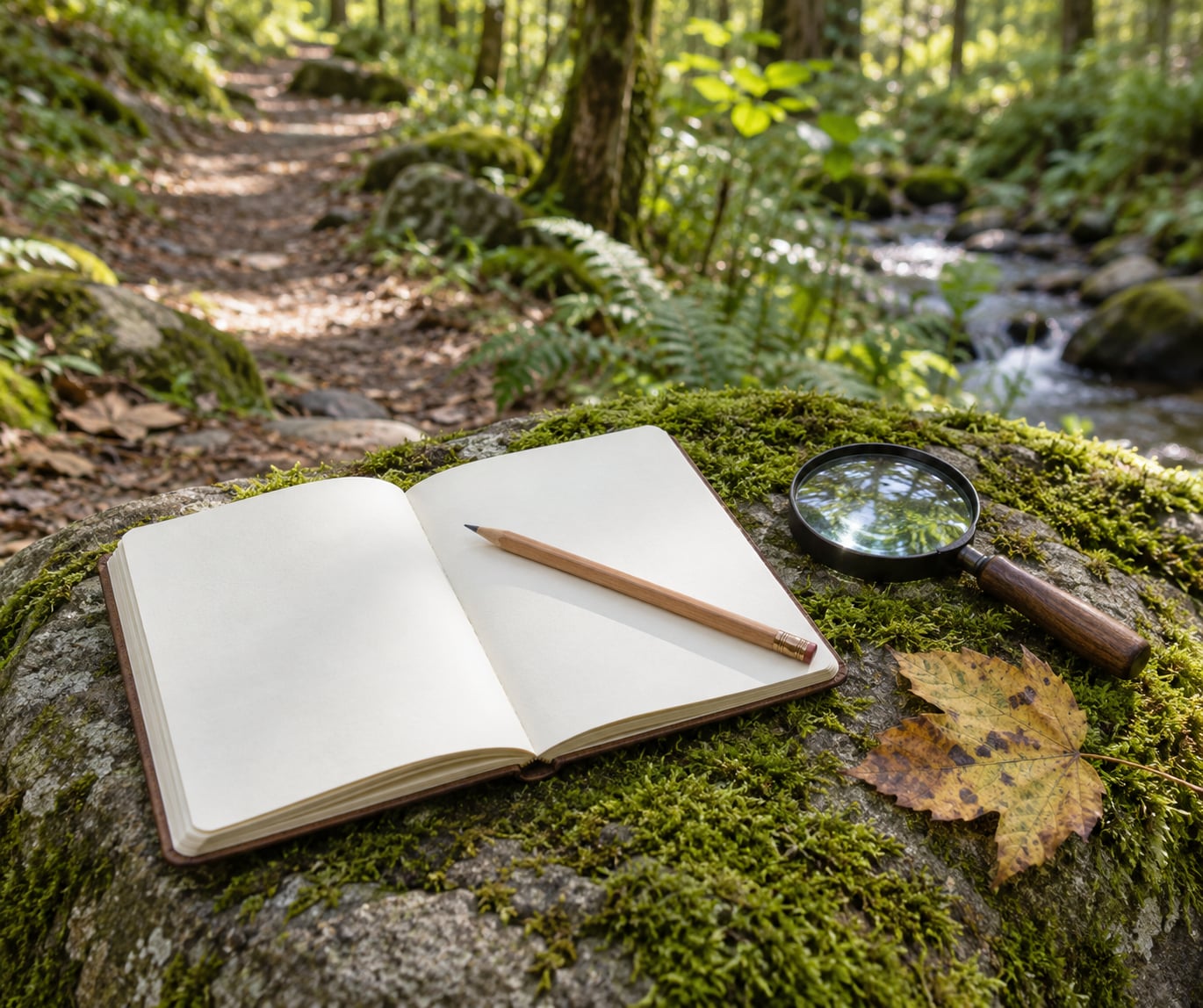
Keeping a nature journal means writing down what you notice outdoors in a small portable notebook: the date, where you were, the weather, one or two plants or animals you saw, and a question you want to answer next time. You need a notebook, a pencil, about ten minutes, and zero drawing ability. Curiosity matters far more than neat artwork.
I kept one on and off for years before it stuck, and the version that finally worked was embarrassingly simple. One page per outing, same five headings every time. That is the whole system, and the rest of this guide is how to make it a habit that lasts past the first month.
What You Need
Start with a pocket-sized notebook and a pencil. That is a complete kit. Everything else is an optional extra that you add only once you know which parts of journaling you actually enjoy.
- Notebook: something small enough that you will carry it without thinking, roughly 3 by 5 inches, with a cover that survives being shoved in a jacket pocket. Paper you can write on with a pencil beats fancy paper you cannot use outdoors.
- Pencil: a regular wooden pencil or a mechanical one. Pencils smear less in damp conditions than ballpoint ink, and you can erase a wrong identification instead of crossing it out.
- One observation habit: decide in advance that every outing gets one page. This is the part that matters more than gear.
Optional tools, added as needed: a regional field guide, a hand lens of 10x for close work, a ruler for measuring leaves and stems, binoculars for distance viewing, your phone camera for photographs you paste or reference later, and a small paper envelope for a fallen leaf or a pressed specimen. A waterproof pen is useful in rain, though pencil works fine in most weather if you keep the page sheltered.
Step-by-Step
Choose a Journal Format
Pick the format that matches how you like to record things, then stop thinking about it. Blank pages suit people who draw or write freely. Lined pages suit people who write sentences. Dated pages remove the single biggest source of blank-page paralysis, because the date is already there. Gridded pages help with measurements and sketches of shape. Illustrated or prompt journals guide you when you have no idea what to write next.
Two named systems are worth knowing. The Grinnell system, named for the American ornithologist Joseph Grinnell, is a research-style format built around species accounts, one page per animal, recording description, habitat, behaviour and measurements. It is excellent but heavy. Free drawing means whatever you saw, however you saw it, and most beginners stay here for a year before trying something more structured.
| Format | Upkeep effort | Handles wet weather | Best for |
|---|---|---|---|
| Blank pages | Low | Poor | People who draw or scribble freely |
| Lined pages | Low | Poor | Writing short observation notes |
| Dated pages | Very low | Poor | Beginners who stall on a blank page |
| Gridded pages | Medium | Poor | Measurements and shape sketches |
| Grinnell species accounts | High | Poor | Repeat observations of the same species |
| Phone or tablet notes | Low | Well | People who want searchable records and photos |
| Hybrid, paper plus photos | Medium | Well | Long-term records you want to refer back to |
Most people end up hybrid: a paper page written in the field, with photographs kept on the phone and matched to the date later. Paper records how the day felt and what you were actually paying attention to. Photos record fine detail you could not draw in ten minutes.
Set Up a Simple Observation System
Write the same five headings on every page, once, and leave room under each. Repetition is what turns a journal into something you can actually use later.
- Date and time. Without a date your notes become unusable within a year.
- Location. A neighbourhood corner is enough. Be specific enough to return to the same spot.
- Weather. Sky conditions, temperature, wind, anything unusual. This is the field people skip and later wish they had written.
- What you saw. One or two subjects described in detail, plus a quick sketch if you like.
- One question. Something you will look for next time, such as whether that nest is still occupied in a month.
You can copy that list onto a single index card and slip it into the front cover of your notebook. That card is the difference between finishing a page in ten minutes and staring at the paper for twenty.
Make Your First Entry
Do not travel far for this one. Pick the tree at the end of your street, the bird on your feeder, an insect on a wall, or a cloud shape. Ten minutes, one page.
Here is what a finished first entry can look like. 3 May, 7.15am. Corner of Beech Road and the park gate. Clear, cold, light wind from the north. Then: a sycamore about fifteen metres from the gate has just opened its first three leaves, all on the lowest branch, and they are pale green rather than the darker green of the mature tree above. One question written at the bottom: which week do the rest of the branches follow?
That is a complete and useful entry. You will know in May exactly which tree you meant, and the second time you pass it you will know what to look for. If your page has a location, a date and one thing you will check again, the entry did its job.
Record Changes Over Time
Repeat visits turn scattered notes into a record. Choose one route, one garden bed, one feeder or one tree, and return to it on a schedule you can keep, such as the first Sunday of each month.
Phenology is the study of recurring seasonal events, first leaf-out, first bloom, first migrating bird, first frost. Written down year after year at one location, your notes become a personal climate record, because flowering and leaf-out dates are among the things that shift as local temperatures change. Most journal keepers find their own timeline shifting too.
Turn repeats into lists. A page titled Sycamore, Beech Road with dates down one side and stage down the other gives you a chart. A list of first-sightings by species makes migration easy to follow. If you record plants and insects as well as birds, you get several seasons of data from a single walk.
If you upload observations to apps such as iNaturalist or take part in a city bioblitz or bioblitz-style survey, your paper dates and locations let you match and check your records later. Most people use the app alongside the notebook rather than instead of it.
Add Sketches, Notes, and Other Details
A sketch is a way of looking, not a way of drawing. Ten minutes spent working out where a leaf attaches to the stem teaches you more than an hour of reading about it. Lines and labels beat accurate art every time, and half the people who describe themselves as bad at drawing produce perfectly usable field sketches.
Other detail that pays off later: measurements such as leaf length or trunk circumference, the number of flowers on one stem, colour described in words as well as pencil, sound notes for birds you heard but did not see, and one sensory line, the smell of wet bark, the temperature of sand in summer. Photographs referenced by date work well too. Rubbings of bark or leaf texture with a pencil and a leaf laid underneath add texture cheaply and take nothing from the tree.
Collect only what is already loose or fallen, and check local rules for protected species before taking anything. Leave nests, occupied holes and plants where they are. Ask before you photograph people on private land.
Review and Use Your Journal
Set aside twenty minutes at the end of each month. Read the month’s pages, add a one-paragraph summary of what changed, and highlight anything you want to follow up. This is the part almost everyone skips, and it is where the journal stops being a pile of notes and starts being useful.
After a few months you will want lists. Who visited the feeder, and when. Which species flowered in the hedgerow. What the weather was doing on the first frost. Keeping those summaries makes year-two entries dramatically easier to write.
Longer term, the journal can feed something outside yourself. Feeding sightings into citizen science projects puts your observations to real use, and comparing your own phenology notes against published records of shifting seasons is a plain, honest way to see climate change at street level rather than in a headline.
Common Mistakes
Trying to make every page good. The fix: write the ugliest entry you can on purpose, early on. Pages three and four are where people stop. Being bad at it for a month is the entry fee.
Recording too little detail. A page saying saw a bird is worthless a year later. Add location, colour, size, behaviour, and one feature that distinguishes it. Three extra lines is enough.
Collecting things you should not. Taking a whole plant, a bird’s egg or anything from a protected area can cause real harm and may be illegal. Collect fallen, abundant material only, and leave the rest.
Waiting for something rare. The most common species near your home appear every single day, and they are the ones people ignore. A robin is a legitimate entry. Regular things are what make a pattern visible.
Letting the pages get ruined. Water, smeared ink and gloves are the complaints that come up most often from people who already keep field notes. Carry the notebook inside a plastic sleeve, keep a spare pencil, and accept that a smudged page is still a page.
Making it stressful. If journaling starts feeling like homework, you have set a schedule you do not want. Drop to one page a month, then one page a week. A journal used rarely is better than a notebook abandoned in a drawer.
The fix for most of these is the same: small, dated, imperfect, repeated.
Frequently Asked Questions
What do I write in a nature journal entry?
Write the same five things every time: date and time, location, weather, one or two subjects you saw described in detail, and one question to follow up. Add a quick sketch if you like. The date, location and weather are the fields people skip and later regret, because without them a page cannot be matched to anything that happened that season.
Do I need to be able to draw to keep a nature journal?
No. Most working field journals are full of rough labels, arrows and scribbles rather than artwork. Sketching is useful because it forces you to look closely at shape, arrangement and texture, not because it produces anything pretty. If drawing feels like a barrier, write descriptions instead and keep photographs for detail.
How often should I write in my nature journal?
Once per outing, however short, is the habit that works. Most people settle on a weekly walk or one visit to a fixed spot each month. Frequency matters more than length, because the value is in comparing entries across time. If you miss a month, carry on. Gaps are normal and the journal does not expire.
Is a nature journal different from a nature diary?
A diary records what happened to you, including your thoughts and the story of the day. A nature journal records what you observed, and you are usually outside writing it. Many people keep both, and the best pages happen when the two merge, when the observation and your reaction to it sit on the same page.
Should I keep a nature journal on paper or on my phone?
Paper survives better, writes faster with cold hands and never runs out of battery, but it cannot be searched. A phone gives you searchable records, photographs and easy data submission to citizen science projects. Hybrid works best for most people: a short paper page in the field, photographs matched to that date at home.
Can children keep a nature journal?
Yes, and it is one of the better ways to get them outside. Keep it short, around five minutes, and let the page be mostly drawing and collecting rather than writing. Give them one prompt at a time, such as find something green that is not a leaf, or draw the biggest footprint you can find. Praise noticing, not accuracy.
Conclusion
Start smaller than feels necessary. Pick one outdoor spot you already visit, write one page with the date, weather, a description of something you saw and one question, then do it again next week. Repeat that a dozen times and you will have a nature journal, a record of seasonal change on your own street, and a habit that has survived past the first month.